The Case in Brief
The Small Connecticut Burying Ground the Warrens Made Famous At the intersection of two unassuming country roads in Easton, Connecticut, a small cemetery is…
The Small Connecticut Burying Ground the Warrens Made Famous
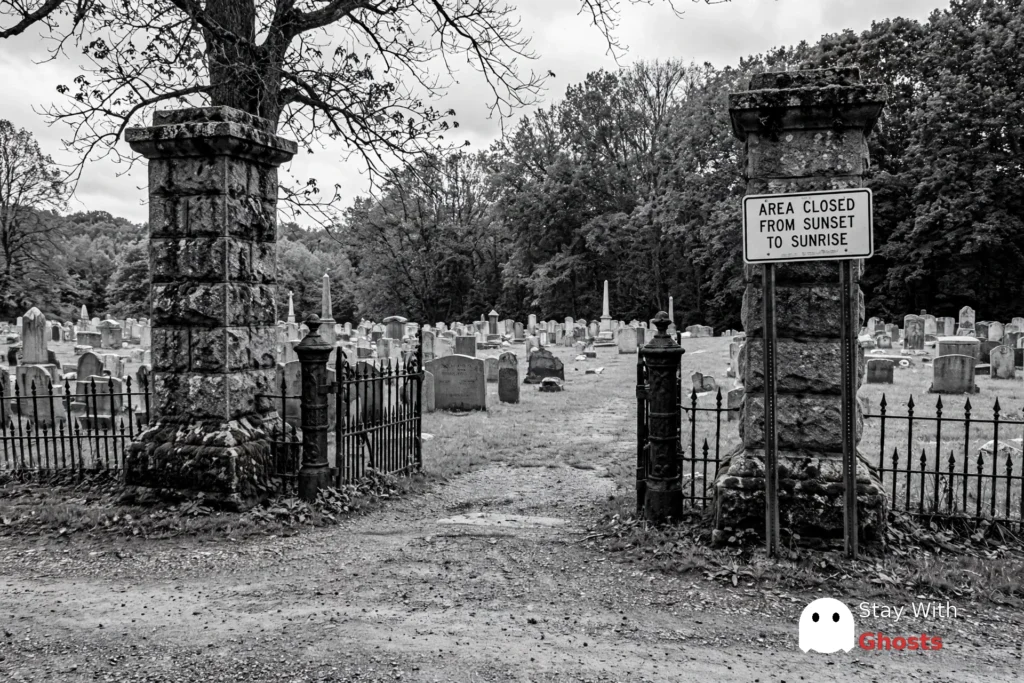
At the intersection of two unassuming country roads in Easton, Connecticut, a small cemetery is tucked behind a low stone wall. Its oldest headstones lean at precarious angles, their inscriptions just barely legible after more than two and a half centuries. Most people who’ve heard of Union Cemetery know it by one name: the most haunted cemetery in New England, its reputation founded almost entirely on one ghost story, involving a woman in white who is said to wander the cemetery and the roadways nearby at night. Fewer people are aware that, despite its reputation, Union Cemetery is actually a small, active local burial ground, where Easton’s residents continue to lay their dead to rest – which is why its ghost story and its reputation as the home of an active vandalism problem are so inextricably linked.
A Parish Burying Ground Older Than the Town Around It
Union Cemetery’s earliest documented burial was in 1761, when a local man, Ebenezer Hubbell, was laid to rest on land belonging to the parish of North Fairfield long before Easton was even incorporated as its own town. Easton was not founded until 1845, carved out of the neighboring town of Weston, which means that the cemetery predates the existence of the community whose name it bears by nearly a century. Its name reflects that same layered history: the grounds served Methodist, Congregational, and Baptist families alike, as a shared burying ground that came to be called simply Union Cemetery, and it sits today directly across from the Easton Baptist Church, built in 1831 at the same crossroads.
The cemetery is located at the junction of Sport Hill Road and Stepney Road, a rural intersection that has changed remarkably little despite Easton growing up around it, and its gravestones carry the names of the same handful of old Connecticut farm families, repeated across generations. Easton has long marketed its own remoteness, still sometimes nicknamed the “Black Pearl of Fairfield County,” for the dark country roads that separate it from its far more developed neighbors along the Long Island Sound coastline, and Sport Hill Road, lined even today with working farms and farm stands, has changed its character less over the last century than almost any other corridor in the county. That isolation is part of what makes Union Cemetery’s setting feel so ready-made for a ghost story: a small graveyard at a dark crossroads, miles from streetlights, has always been the kind of place local imagination gravitates towards.
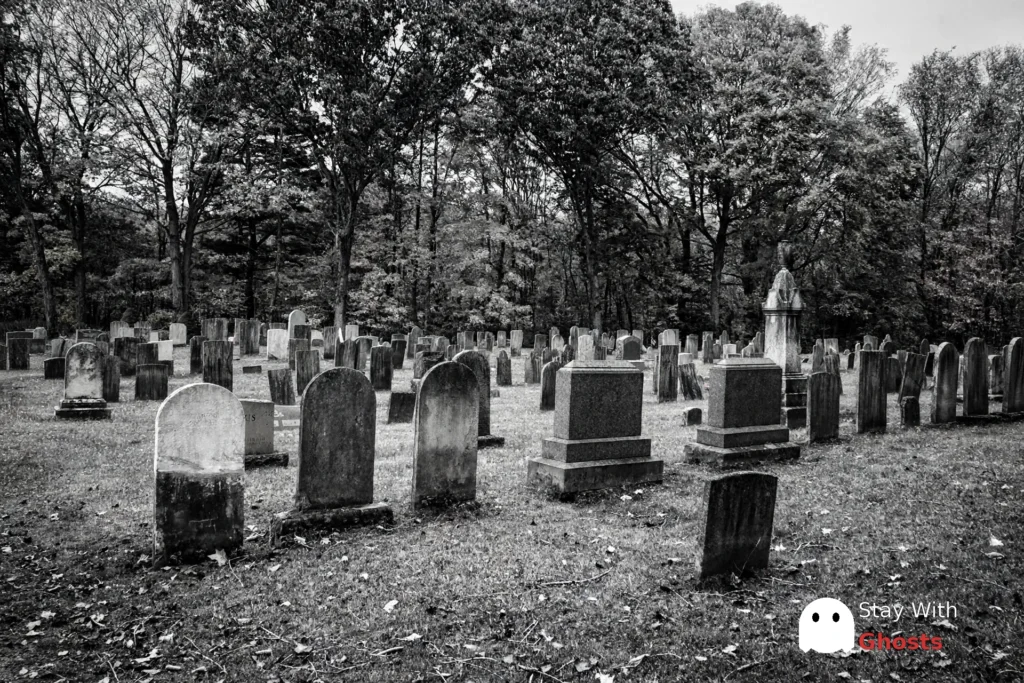
Like many burial grounds of its age, Union Cemetery has had active defenders in recent decades. In August 2012, vandals broke or snapped fifty-one headstones from their bases that very night, causing damage estimated at more than fifty thousand dollars, and in 2019, roughly forty more stones were damaged, many of which remain unrepaired for lack of funding. The Historical Society of Easton has since partnered with the cemetery in an ongoing preservation effort, running an adopt-a-headstone program to preserve its most fragile monuments, while local volunteers, including cousins Bruce and Bob Laskay, have organized cleanup days that drew some twenty-five community members and descendants back to care for the grounds in 2022 alone. Union Cemetery’s earliest documented burial dates to 1761, when a resident named Ebenezer Hubbell was interred on land that then belonged to the parish of North Fairfield, decades before Easton existed as its own town. Easton was not incorporated until 1845, carved out of neighboring Weston, which means the cemetery predates the very community whose name it now carries by nearly a century. Its name reflects that same layered history: the grounds served Methodist, Congregational, and Baptist families alike rather than any single denomination, a shared burying ground that came to be called simply Union Cemetery, and it sits today directly across from the Easton Baptist Church, built in 1831 at the same crossroads.
The cemetery occupies the junction of Sport Hill Road and Stepney Road, a rural intersection that has changed remarkably little even as Easton grew up around it, and its gravestones read like a record of the same handful of old Connecticut farm families repeated across generations. Easton itself has long marketed its own remoteness, still sometimes nicknamed the “Black Pearl of Fairfield County” for the dark, unlit country roads that separate it from its far more developed neighbors along the Long Island Sound coastline, and Sport Hill Road, lined even today with working farms and farm stands, has changed its character less over the last century than almost any other corridor in the county. That isolation is part of what makes Union Cemetery’s setting feel so ready-made for a ghost story: a small graveyard at a dark crossroads, miles from streetlights, has always been the kind of place local imagination gravitates toward.
Like many burial grounds of its age, Union Cemetery has needed active defenders in recent decades. In August 2012, vandals toppled or snapped fifty-one headstones from their bases in a single night, causing damage estimated at more than fifty thousand dollars, and in 2019 roughly forty more stones were damaged, many of which remain unrepaired for lack of funding. The Historical Society of Easton has since taken up an ongoing preservation partnership with the cemetery, running an adopt-a-headstone program to fund the conservation of its most fragile monuments, while local volunteers, among them cousins Bruce and Bob Laskay, have organized cleanup days that in 2022 alone drew some twenty-five community members and descendants back to care for the grounds.
The Ghost Story That Arrived With the Twentieth Century
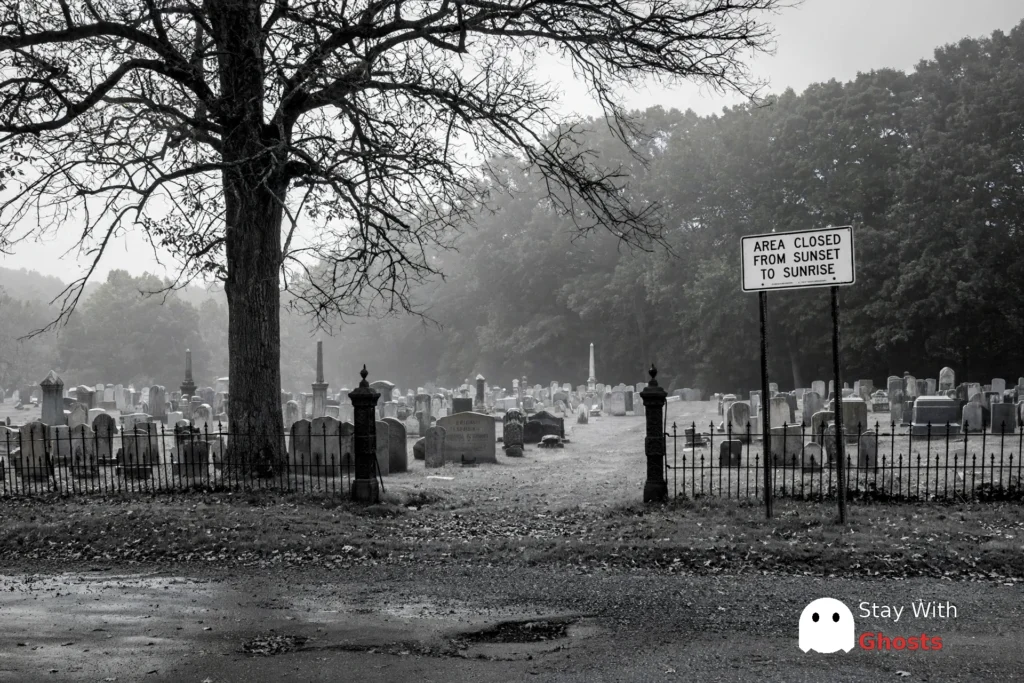
Union Cemetery’s reputation for being haunted may well be a relatively recent addition to its long history. As found in the research of paranormal investigators, sightings of a single female ghost began circulating in the late 1940s, several decades after most of the cemetery’s graves had been dug. This does not detract from the fact that the haunting has since become inexorably linked with the cemetery’s nineteenth-century dead. Local historians have named two women whose remains lie within Union Cemetery as potential candidates for the identity of the vengeful spirit. The first, Harriet Seeley Bryan, died in 1836, just nine days after her wedding, while the second Harriet Seeley passed away in 1853, eight days after giving birth to a son who did not live beyond his mother. Neither death was ever officially connected to the legend, but the mere existence of two Harriets in the cemetery has led some to believe that one of them must surely be the ghostly figure.
Why Union Cemetery Is Considered Haunted
The White Lady of Sport Hill Road
The ghost that haunts Union Cemetery is called the White Lady. It is said to be a young woman dressed in a white nightgown or a white old-fashioned wedding dress with a veil or a white cap and dark hair trailing over her shoulders. The White Lady appears in the cemetery and on the road adjacent to it, Sport Hill Road. Many drivers have seen the apparition come darting out from the cemetery only to vanish just before a collision. According to one story, a firefighter saw the figure come out from behind a tree and walk or run towards his car. The car made a sound as if it hit something, but there was no crash. The fireman’s car’s hood was dented, but no accident was found. Many paranormal investigators have photographed the Union Cemetery at sunset and nightfall. They have found that they captured a large number of strange orbs and other lights and had several instances of cold spots, camera and tape malfunctions, and electronic voice phenomena.
Ed and Lorraine Warren’s Night at the Gate
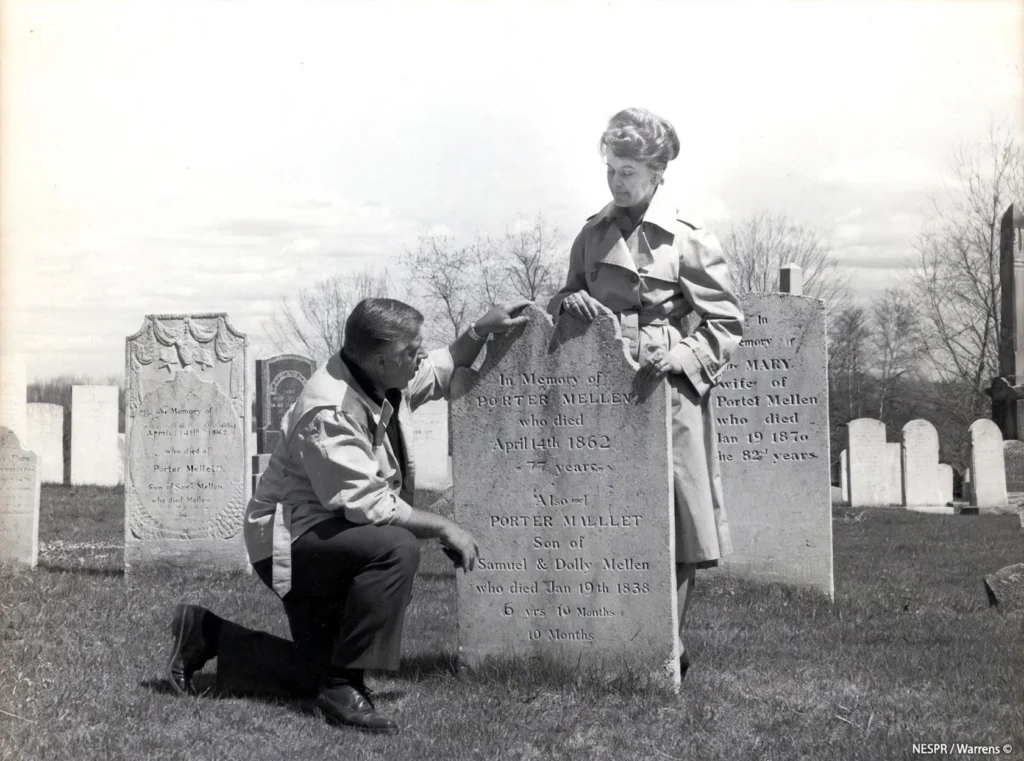
Photo: NESPR / Warrens ©
No source was more responsible for associating the Union Cemetery with the paranormal mainstream than Ed and Lorraine Warren, the Connecticut-based demonologist and clairvoyant pair who investigated the cases of the Amityville and Perron families, which led to them becoming the most recognizable paranormal researchers in the country and the basis for a long-running film franchise several decades later. The Warrens dedicated the early section of the book, which they wrote with Robert David Chase and shared its eponymous title with the cemetery’s grounds, to Union Cemetery particularly, describing the White Lady as a young woman who they believed died in her twenties, possibly in childbirth. Ed Warren claimed that his most significant encounter took place in the early hours of September 1, 1990, when he watched the cemetery gate overnight and recorded roughly five seconds of video he described as a misty, womanlike shape that coalesced between the headstones before fading away. “I heard a woman weeping,” said Warren of the encounter, and the resulting clip has often been cited in subsequent decades as among the most widely circulated pieces of amateur ghost footage from the era.
A Regular Stop on Connecticut’s Ghost-Tour Circuit
The promotion of Union Cemetery by the Warrens did not die with the twentieth century; indeed, their legacy has only gained ground in recent years. According to a 2023 academic study of the American legend-tripping culture (published by the University Press of Mississippi and partly based on the research materials in the JSTOR folklore collection), they should be credited with popularizing the very idea of Union Cemetery as a haunted place and making it a staple destination in a certain tradition of regional ghost-tourism. A researcher following paranormal-themed YouTube content creators recounts in the article how they often regard Union Cemetery as the perfect launching pad for what legend-seekers refer to as a serial trip. An overnight tour of legends that highlights multiple seemingly haunted sites. A favored method to enhance the experience is to drive from Union Cemetery to Evergreen Cemetery in New Haven, taking about thirty minutes, where Midnight Mary awaits the daring and curious at the opposite end. Alternatively, those same serial legend seekers might choose to extend the trip by heading to Stepney Cemetery in nearby Monroe, linked to the White Lady myth, the final resting place of the Warrens themselves: Ed and Lorraine. The same article contains the author’s personal quest to encounter the White Lady in the Union Cemetery, which, as the legend goes, failed to deliver but served as a fitting prologue to a similar adventure at the Stepney Cemetery, which the author undertook with equal zeal to document.
The Watcher at the Fence Line, and the Fire Across the Road
The White Lady is not the only legend associated with Union Cemetery. According to the article, paranormal investigator John Zaffis, relative of the Warrens and an amateur sleuth with a good reputation, saw a dark figure several times. This dark figure was not something that wandered the grounds of Union Cemetery proper, but rather a cloaked or shadowy figure that walked along the outer perimeter of the cemetery’s fence. Another story told by a visitor is of a pair of glowing red eyes that come from the trees behind the cemetery. The eyes are said to belong to a man named Earle Kellogg who burned to death in a fire that happened directly across the road in 1935. It is impossible to say if the stories are of two separate entities or just the same one seen in different ways by different people, but both have become part of the legend of the White Lady of Union Cemetery.
That reputation has not gone unchallenged. The folks at the New England Skeptical Society have paid a visit to Union Cemetery, just to check it out, to see if there’s any reason Warren’s telling stories about ghost hunters having run-ins with poltergeists in the place. They don’t find any evidence of anything at all that’s fit to be called supernatural – just an old New England graveyard, save that they save their sharpest rebukes for the legend itself. They say that decades of promoting paranormal activities have brought in precisely the sort of unwanted visitors who have vandalized the grounds and trespassed, again and again, damaging many of the cemetery’s actual, physical monuments.
Visiting Union Cemetery Today
Union Cemetery is located on the corner of Sport Hill Road (Route 59) and Stepney Road (Route 136) in Easton, Connecticut, across from the Easton Baptist Church. It is an active burial ground that still serves residents who have family plots there, and is not a tourist attraction with a gift shop and no entrance fee of any kind.
That fact is more important than it would be at any other haunted location, as Union Cemetery’s ghost story has a documented history of being a catalyst for vandalism. It is posted as closed to visitors after hours, as per local ordinance, because of years of ghost hunters and thrill-seekers damaging the headstones on the property, including the theft and vandalism of dozens of historic headstones in 2012 and again in 2019; unlike the Stanley Hotel or the Tower of London, there is no ticket booth with a gift shop beyond, no guided walks offered, and no official channels set up to accommodate paranormal tourism of any kind, and the cemetery’s caretakers are, to a degree, more concerned with repairing damage than with entertaining ghost hunters, with every account of the White Lady’s most recent decades coming with an account of some new stretch of vandalism in its wake.
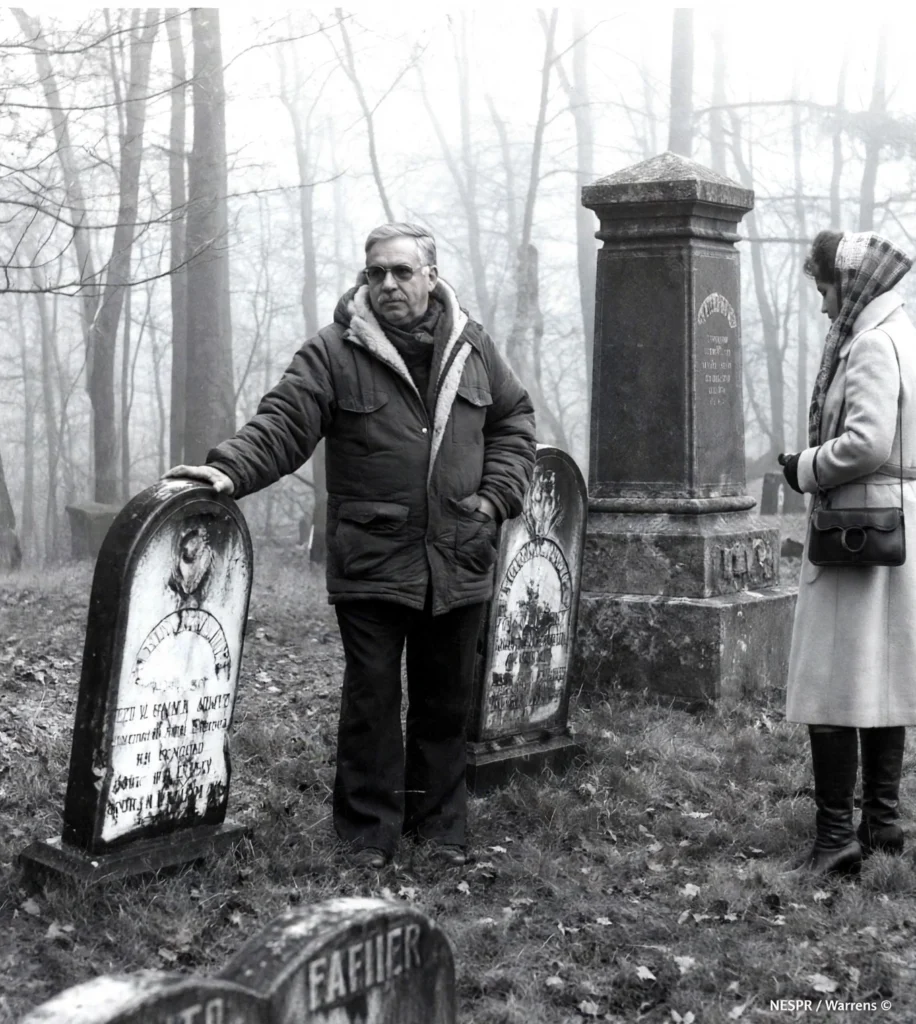
Photo: NESPR / Warrens ©
Anyone wandering around at daylight hours, when the cemetery is open to the public and functions much like any other burial ground, is kindly requested to take the proper measures of respect one would for any working cemetery: leave private plots alone, don’t touch or lean on aging monuments, don’t block the entrance with your vehicle of choice by parking on the shoulder of Sport Hill Road, and keep in mind that the people buried here have living descendants still, some of whom visit and tend to their graves from time to time. Those who wish to do more to preserve the history of this hallowed ground and its peculiar residents can do so by supporting the Historical Society of Easton’s adopt-a-headstone preservation program, which provides much-needed funds to actually conserve the cemetery’s most decayed and damaged monuments, instead of merely writing tales of the supernatural and setting them up for display; a small token of appreciation for a graveyard that has spent the better part of a century as an attraction, rather than the resting place it was always intended to be for Easton’s dead.
Would you folks make the trek out to Sport Hill Road in daylight to see the White Lady’s cemetery for yourselves, or is this tale best kept for retelling? Share your thoughts in the comments below.
Sources consulted for the historical details in this post include Jeffrey S. Debies-Carl, “Preparations and an Uncanny Journey,” in If You Should Go at Midnight: Legends and Legend Tripping in America (University Press of Mississippi, 2023), pp. 89–114; Ed Warren, Lorraine Warren, and Robert David Chase, Graveyard: True Hauntings from an Old New England Cemetery (St. Martin’s Press, 1992); the Wikipedia entry on Union Cemetery (Easton, Connecticut); the Historical Society of Easton Connecticut’s Union Cemetery Preservation Project page; the Easton Courier’s reporting on the cemetery’s 2012 and 2019 vandalism incidents; and the New England Skeptical Society’s published account of its own investigation of the site.