The Case in Brief
The Hotel a Dying Man Built, and Stephen King Never Forgot The Stanley Hotel sits above the town of Estes Park, glowing like a cinematic dream in gleaming…
The Hotel a Dying Man Built, and Stephen King Never Forgot

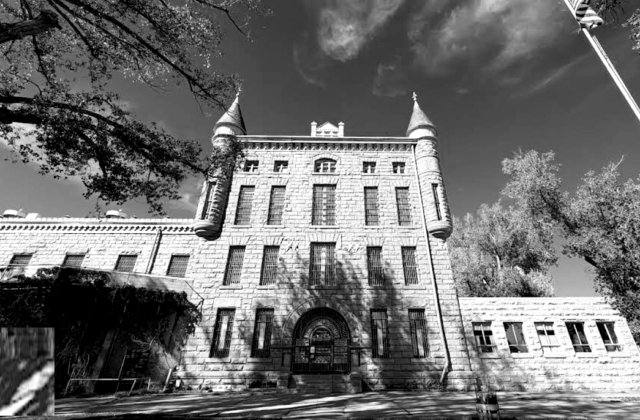
The Stanley Hotel sits above the town of Estes Park, glowing like a cinematic dream in gleaming white and red-tiled roofs. A horror novelist was drawn to it in 1974, before he ever laid eyes on the place, and he found no reason to change his mind.
Most people know the Stanley as the real-life model for the Overlook Hotel in Stephen King’s The Shining. Fewer know that its founder was given months to live, that a chambermaid was shot clean through a ceiling and kept on as a staff member for four more decades, or that the hotel’s very founders are the specters most frequently reported by guests.
A Dying Man’s Gamble on Mountain Air
Freelan Oscar Stanley, better known to most as F.O., was born June 1, 1849, in Kingfield, Maine, along with his identical twin brother, Francis Edgar Stanley. The two Stanley brothers would go on to found two very different fortunes; first the Stanley Dry Plate Company, a photography business that Eastman Kodak would eventually buy out, and the Stanley Motor Carriage Company, the producer of the steam powered automobile known as the Stanley Steamer.
By the time he turned 54, F.O. Stanley was a rich man, and a dying one, as he was diagnosed with tuberculosis and given only months to live by the doctors. Stanley and his wife Flora arrived in Denver on March 4, 1903, upon the recommendation that the dry climate of the Rocky Mountains may prove beneficial to his condition.
It would, in fact, do more than just prove to be beneficial. By the time Stanley arrived in Estes Park proper on the morning of June 30, 1903, and in a most dramatic and unorthodox fashion, according to one historian, which served as his introduction to the community of Estes Park, his health had miraculously improved to the point where he decided to stay.
The valley Stanley came to find himself in, however, had a contentious past of its own. The valley had previously been the site of a visit by an Anglo-Irish nobleman, the Earl of Dunraven, who came in 1872 on a hunting party and built both a lodge and hotel of his own in addition to attempting to illegal homestead as much as 6,000 acres to build a private hunting preserve, a claim that the local settlers of the area, and the MacGregor family in particular, would contest for many years. Stanley eventually purchased land from both, with the intent of building his own grand resort hotel, which he eventually did, and put Estes Park on the map.
The First Fully Electric Hotel in the World
The construction of the Stanley Hotel began in 1906 and was completed on June 22, 1909. By all accounts, this hotel was the first in the world’s history to be electrified, relying on Stanley’s own hydroelectric power station.
Stanley personally oversaw almost every aspect of the hotel’s early operations, including organizing his own private steam car traffic from the train to the hotel, transforming this mountainous outpost into a popular tourist destination. This great innovator and businessman did not have time to enjoy his own creation for very long. F.0. Stanley sold the hotel, the power plant, and his land to the railway company in February 1926, barely twenty years after its opening.
The Explosion in Room 217
The Stanley’s most spectacular incident occurred in 1911, about two decades after the hotel’s opening. During a severe storm, which caused a power outage, the head chambermaid of the establishment, Elizabeth Wilson, had to manually light the gas lamps in Room 217. However, there was a leak of acetylene gas, which engulfed the entire room.
The moment she lit a match, the whole space was engulfed in flames and explosion, which sent Elizabeth flying from the second-floor room down to the first-floor MacGregor Dining Room, through the floor.
Surprisingly, the woman survived the accident with only two fractured ankles. F.O. Stanley, in turn, covered all her expenses and provided a lifelong pension, to ensure that Mrs. Wilson could afford to retire. Elizabeth continued working for the Stanley until the 1950s.
A Horror Novelist’s Off-Season Stay
Stanley’s association with The Shining started long before the infamous 1911 explosion. In 1974, Stephen King and his wife Tabitha, who at the time lived in nearby Boulder, checked into the hotel on its closing season and became its only overnight guests.
They had dinner in an empty dining room, complete with piped-in orchestral music, wandered the empty hallways, and spent the night in Room 217, the one destroyed during the 1911 blast. King later claimed to have a vivid and unpleasant dream about his young son being chased by a fire hose in the corridor that night, which found its way into his novel written in 1977.
The fictional Overlook Hotel in King’s book subsequently had a room number 217, the same as the one rented by the author and his wife. However, in the 1980 film adaptation, shot in a different hotel, the number was changed to 237, presumably to avoid keeping the Stanley’s guests away from Room 217 on the night of the filming due to superstitions.
Why the Stanley Hotel Is Considered Haunted
Flora Stanley’s Piano

F.O. Stanley bought a Steinway grand piano as a gift for his wife on the day the hotel was opened. Flora was an amazing pianist who played this piano in the hotel’s music room during her stay. Even after her death in 1939, guests and employees of the hotel claim to hear piano music coming from the music room. It is also stated that the piano keys of the Steinway piano are seen to depress themselves by unknown forces, but the music stops playing as soon as someone enters the room to investigate.
The Chambermaid Who Never Really Left
Room 217 is considered to be Stanley’s most haunted room, associated with the chambermaid who was almost murdered there in 1911, Elizabeth Wilson. Those who have stayed in this room report seeing signs of a domestic situation, rather than supernatural activity for the most part, things such as suitcases that weren’t claimed to be put away, shoes that have been neatly arranged at the end of the bed, and lights that have been switched off and back on as though there is still someone there cleaning as she did a hundred years before her death.
F.O. and Flora, Still Watching Over the Lobby

The hotel’s founders themselves are seemingly the most common sight. F.O. Stanley, who died in 1940 at the age of 91, one year after Flora, has apparently appeared at the front desk of the hotel as guests arrive, so realistically that staff thought he was a well-dressed guest until he disappeared.
Both Stanleys have also allegedly appeared together, holding hands on the hotel’s spectacular, wide spiral staircase while watching the arrivals and departures of the lobby below as if they still watched over their creation. Another presence reportedly haunts Room 407, hovering near the bathroom door: locals attribute it not to the Stanleys at all, but to the Earl of Dunraven, the hotel’s land-hungry predecessor in the valley.
Visiting the Stanley Hotel Today
The Stanley Hotel is a fully functioning hotel and event space in Estes Park, Colorado, at the eastern entrance to Rocky Mountain National Park, which embraces its ghostly reputation rather than shying away from it. The hotel offers Historic Day Tours, which can include a look into the life of F.O. Stanley, an insight into the early history of the town, or a chance to discover the Stephen King connection, and Night or Paranormal Tours that are more centered around the hotel’s ghostly tales, which normally take around an hour and cost about $25 to $35 per person in 2026.
As for overnight stays, guests can opt for any of the hotel’s room categories or choose between the “spirited rooms” option, which includes the most famous Room 217, as well as 401, 407, and 428, and cost around $196 per night, depending on the season. Given the popularity of both tours and the haunted rooms, it is advisable to book excursions and accommodation in advance and check the hotel’s website for the latest information and tour availability.
Would you book a night in Room 217, or would you rather admire the Stanley from a safe distance? Let us know in the comments below.
Sources consulted for the historical details in this post include James H. Pickering, “F. O. Stanley and the Development of Estes Park,” in America’s Switzerland: Estes Park and Rocky Mountain National Park, the Growth Years (University Press of Colorado, 2005), pp. 53–88 (accessed via JSTOR); Andrew Scahill, “Guest Editorial: Audiences and Adaptation,” Literature/Film Quarterly*, Vol. 45, No. 4 (Fall 2017) (accessed via JSTOR); Legends of America’s history of the Stanley Hotel; History Colorado’s entry on the Stanley Hotel; Visit Estes Park’s multi-part Stanley Hotel history series; and the Stanley Hotel’s official tours and visitor information for current visiting details.*