The Case in Brief
A Millionaires’ Social Club Built on Comstock Silver, Where the Basement Once Doubled as a Winter Morgue Virginia City, Nevada, sits on a Nevada…
A Millionaires’ Social Club Built on Comstock Silver, Where the Basement Once Doubled as a Winter Morgue
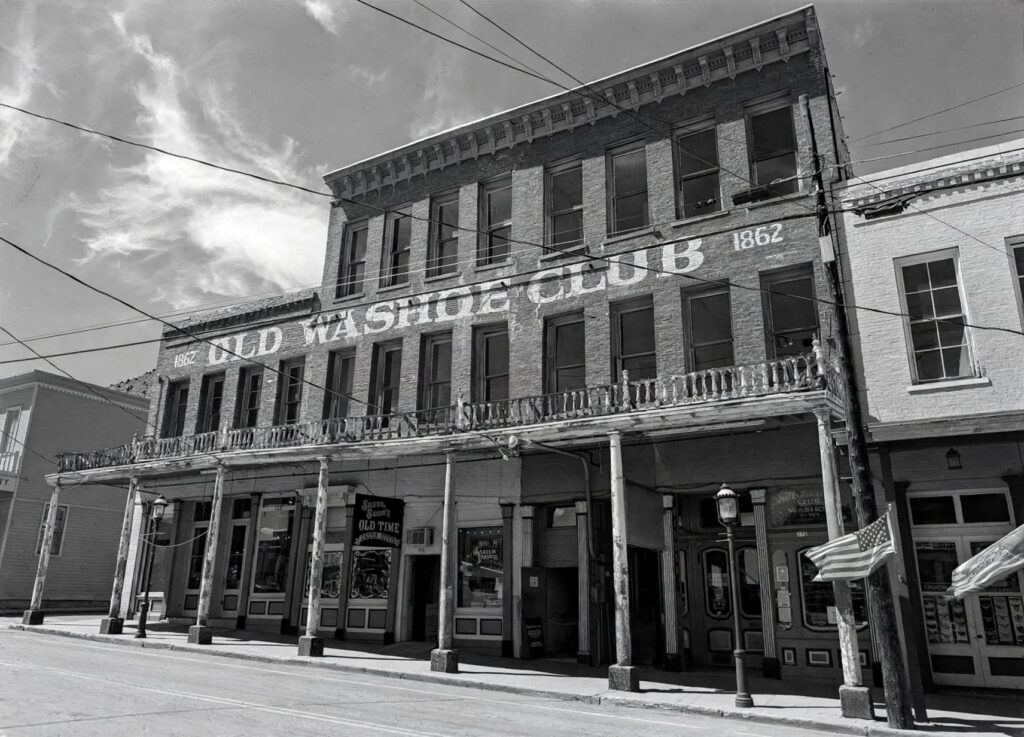
Virginia City, Nevada, sits on a Nevada hillside so rich in silver that it turned anonymous prospectors into some of the wealthiest men in America almost overnight, and nowhere in town captured that transformation quite like the Washoe Club.
Built to give the Comstock Lode’s newly minted millionaires a place to drink, talk business, and be seen among their own kind, the club spent little more than two decades as the undisputed social heart of the richest square mile in the West before the silver ran out and took the club’s membership with it.
Today the same three-story brick building on C Street operates as a museum and saloon, and its main draw for most visitors has nothing to do with mining fortunes at all: a spiral staircase reportedly haunted by a woman in blue, a mischievous prospector who steals unattended drinks at the bar, and a basement space that once served, quite literally, as a place to keep the dead until the ground thawed enough to bury them.
The Discovery That Built a City
The wealth behind the Washoe Club began with a mining claim and a case of spectacularly bad luck. In 1859, a miner nicknamed Old Virginny, whose real name was James Finney, worked a claim at the head of Six Mile Canyon alongside Peter O’Riley and Patrick McLaughlin, and the three men stumbled onto the rich silver veins of what became known as the Comstock Lode while placer mining for gold.
According to the origin story later recounted by historians, the rest of the mining camp had recently formed a vigilance committee and, in their eagerness to hang accused claim jumpers, had inadvertently scared off two other prospectors from a nearby claim, leaving Six Mile Canyon open for O’Riley and McLaughlin to quietly work and strike the rich Ophir Chimney themselves.
It was a discovery built, in other words, on other men’s mistakes as much as on skill, and it turned an obscure Nevada hillside into the site of the richest silver strike in American history almost overnight. Word of the Ophir Chimney’s rich ore spread fast enough that within months, prospectors and speculators were pouring over the Sierra Nevada from California by the thousands, and a tent camp on the site grew, in a matter of a few short years, into a genuine city complete with its own mining exchange, banks, and newspapers.
Finney himself, for what it’s worth, never profited much from the discovery that carried his nickname; like a great many of the men who found the original claims along the Comstock, he sold out early and cheaply, long before anyone fully understood just how much silver actually ran beneath that hillside.
The Bonanza Kings and a City of Instant Millionaires
Development of the Comstock’s deeper, richer seams stalled for a period after the initial 1859 strike, until a group of Irish mine owners who came to be known as the Bonanza Kings took control of the mines and began extracting silver on a scale that reshaped the entire region. Their operations are estimated to have yielded more than half a billion dollars in silver, an amount that required an enormous skilled workforce paid unusually high wages to make the dangerous, deep-shaft work worth doing.
That wealth transformed Virginia City from a rough mining camp into a genuinely cosmopolitan boomtown almost overnight, complete with an opera house, multiple newspapers, and, before long, a private club built specifically so its newly wealthy mine owners, bankers, and speculators would have somewhere suitably exclusive to spend their evenings.
The presence of sympathetic Irish ownership at the top of the Comstock’s biggest mines also meant Irish workers and their families found unusually steady, well-paying work and a welcoming community in Virginia City at a time when Irish immigrants faced open discrimination in much of the rest of the country, an unusual reversal that let the Comstock’s Irish population flourish rather than merely survive.
By the mid-1870s, Virginia City was routinely described as one of the wealthiest cities per capita anywhere in the United States, a reputation built almost entirely on ore that would, within another generation, simply run out.
A Club Built for Millionaires
The Washoe Club opened its doors on June 1, 1875, and quickly became known around Virginia City simply as the Millionaires’ Club, a private social institution built to serve the town’s mining magnates and the professional class that had grown up around them.
Its original quarters featured plate glass windows, upholstered furniture, and a mantle crowded with bronze statuettes, the kind of ostentatious comfort meant to signal exactly how far its members had come from the mining camps where many of them had started. That first building burned down after only five months, but the club’s members were wealthy enough to treat the fire as a minor inconvenience rather than an ending, and by 1876 they had rebuilt in a three-story brick building on C Street that still stands today.
The rebuilt club included eight private apartments, a reading room, a billiard parlor, artwork by the landscape painter C. B. McClellan, and, in a detail that says a great deal about what the Comstock’s newly rich valued most, a private telegraph line kept constantly updated with the latest stock market prices from San Francisco.
Gilded Age Club Life, on the Edge of the Frontier
The Washoe Club was, in other words, exactly the kind of institution the whole country was building during the same years, just located somewhere far more remote than most. Historians of the era have grouped it alongside the Bohemian Club in San Francisco, the California Club in Los Angeles, and the Chicago Club as one of the most prominent private gentlemen’s clubs of the entire Gilded Age landscape, an unusual distinction for a club sitting on a Nevada mountainside rather than in one of the era’s great coastal cities.
The writer Francis Gerry Fairfield, describing the appeal of the gentleman’s club generally in his 1873 book The Clubs of New York, observed that such a club let a man see his friends, write his letters, and dine surrounded only by people he considered his social and financial equals, a description that applied just as well four states away in Virginia City as it did in Manhattan.
Guests of real national stature made the trip to see it for themselves: former president Ulysses S. Grant visited during his post-presidency world tour, and the actor Edwin Booth, one of the most celebrated Shakespearean performers of his generation, was also received as a guest, a reminder of just how far the Comstock’s money and reputation reached.
Membership itself was never open to just anyone with money; timber baron D. L. Bliss, whose lumber operations helped supply the timber that shored up the Comstock’s deep mine shafts, was among the club’s prominent members, and admission generally required exactly the kind of mining, banking, or business standing that separated Virginia City’s new elite from the miners actually working underground on their behalf.
Decline and Closure
The same silver that built the Washoe Club eventually doomed it. As the richest Comstock veins played out through the 1880s and 1890s, Virginia City’s population and its once-flush membership rolls both went into steady decline, and a club built entirely around displaying and enjoying sudden mining wealth had little reason to exist once that wealth started leaving town.
The Washoe Club formally closed in 1897, and a local newspaper marking the occasion captured just how significant its end felt to the town, writing that “the closing of the Washoe Club marks an era in the history of Nevada.” Virginia City itself avoided the fate of so many other played-out Western boomtowns thanks to its eventual designation as a National Historic Landmark in 1961, a status that helped fund the restoration of the C Street building that had once housed the club.
The Basement That Served as a Winter Morgue
Long before it became a tourist attraction, the Washoe Club building held a use far grimmer than billiards and stock tickers. During Virginia City’s harsh winters, the ground froze too solid for gravediggers to dig new plots, and according to local accounts a room in the Washoe Club building was pressed into service as a holding area for the dead until burials could resume in the spring.
It is precisely the kind of practical, unsentimental arrangement common to isolated mining towns everywhere, and it has become, understandably, one of the central details cited by every paranormal investigator and tour guide who has ever tried to explain why this particular building has such a reputation for restless energy today.
Virginia City as a whole buried a remarkable number of people relative to its size during the boom years, given the constant toll of mining accidents, disease, and violence in a town built almost entirely around dangerous underground labor, and a private club’s basement pressed into service as informal cold storage for the dead says as much about the town’s practical realities as any of its grander architecture does.
Why Visitors Call It Haunted
The Washoe Club’s most famous resident spirit is a woman in a blue dress, commonly called the Lady in Blue, most often reported near the top of the building’s ornate spiral staircase; some telling of her story identify her as a local woman named Lena, said to have been murdered somewhere on the premises, though that detail is impossible to verify against any historical record.
Visitors and staff also describe a frightened-looking young girl in white seen on the stairs, along with reports of small, invisible hands touching or grabbing people as they climb, and a playful male spirit nicknamed the prospector who is blamed for emptying unattended shot glasses at the bar, moving barstools, and occasionally holding doors open for women guests.
Shadow figures on the building’s upper floors, unexplained EVP recordings, and photographs guests describe as unexplainable have all added to a reputation solid enough to bring paranormal television crews from both Ghost Adventures and Ghost Hunters through the club’s doors.
Staff running present-day tours actively encourage visitors to take their own photos and record their own audio while moving through the building, on the theory that an ordinary guest’s phone is just as likely as a professional investigator’s equipment to catch something nobody in the room actually saw or heard happen.
Visiting the Washoe Club Today
The Washoe Club operates today as a combination museum, saloon, and haunted-tour attraction at 112 S. C Street in Virginia City, with guided tours generally running daily from around 11 a.m. to 5 p.m., typically departing on the hour and covering all three floors of the building including the spiral staircase and basement crypt.
Museum admission runs in the neighborhood of $8 to $10 for adults and roughly $5 for visitors under 16, and because the hourly tours are popular enough to sell out, calling ahead to the club directly is worth doing before making the trip up the mountain.
For anyone who wants more than a forty-minute daytime walkthrough, the club also offers private overnight paranormal investigations for a flat group rate of around $400, which includes full access to every floor plus a small required per-person membership fee, a nod to the fact that this is still, on paper, a private club more than a century after it first opened its doors to Comstock millionaires.
Does knowing the Washoe Club was built entirely on the fleeting wealth of a silver rush make its long afterlife as one of the West’s most talked-about haunted buildings feel like fitting irony, or does the true story of Comstock fortunes rising and vanishing within a single generation not need any ghosts to feel unsettling on its own? Let us know in the comments below.
Sources consulted for the historical details in this post include Alan J. M. Noonan, “Mirages in the Desert,” in Mining Irish-American Lives: Western Communities from 1849 to 1920, University Press of Colorado (2022), pp. 99–130; Cecelia Tichi, “Location, Location, Location,” in Gilded Age Cocktails: History, Lore, and Recipes from America’s Golden Age, Washington Mews Books (2021), pp. 43–66; the Government Publications listing of the Old Washoe Club, Virginia City Historic District in Art Documentation: Journal of the Art Libraries Society of North America, Vol. 8, No. 4 (1989); Paranormal Legacy’s and Haunted US’s histories of the Washoe Club; Atlas Obscura’s entry on the Washoe Club Haunted Museum & Saloon; and Travel Nevada’s and the Washoe Club’s own current visiting and ghost-tour information.