The Case in Brief
Louisville’s Historic, Haunted Landmark At the corner of Fourth Street and Muhammad Ali Boulevard in downtown Louisville, the Seelbach Hotel has been welcoming guests…
Louisville’s Historic, Haunted Landmark
At the corner of Fourth Street and Muhammad Ali Boulevard in downtown Louisville, the Seelbach Hotel has been welcoming guests since 1905 with the kind of Beaux Arts opulence that made it an essential stop for presidents, gangsters, and literary legends alike. It has, according to more than three decades of staff and guest accounts, been home to one of the best-known hotel ghosts in the American South. It is a story that, unlike many hotel legends, is rooted in a real, documented death.
Between its literary pedigree, its Prohibition-era gangster history, and its reported hauntings, the Seelbach has more going on than most historic hotels manage in a century. Here’s what’s documented.
Built by Immigrant Brothers, Timed for the Derby
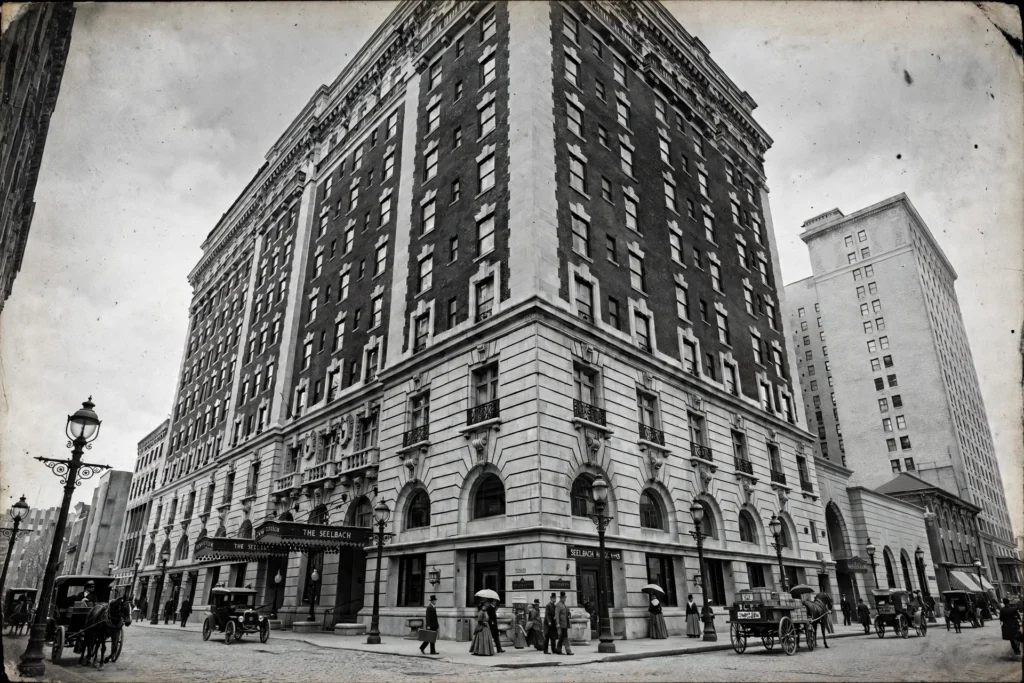
The Seelbachs’ history traces back to the two Bavarian-born brothers—Louis and Otto Seelbach, who emigrated from Frankenthal, Germany. Louis arrived in Louisville in 1869 and, at the age of only 17, opened Seelbach Bar & Grill in 1874, becoming a prosperous entrepreneur overnight. Later, the Seelbach Hotel Company was established by the brothers, and the hotel at Fourth and Walnut Streets was opened in December 1903.
It was officially opened on May 1, 1905, which was the day of the Kentucky Derby – a sign that the place had been chosen deliberately. Over 25 thousand visitors showed their appreciation on the opening day, while the hotel hosted a gala dinner on its opening evening, with dinner parties held in all 150 rooms.
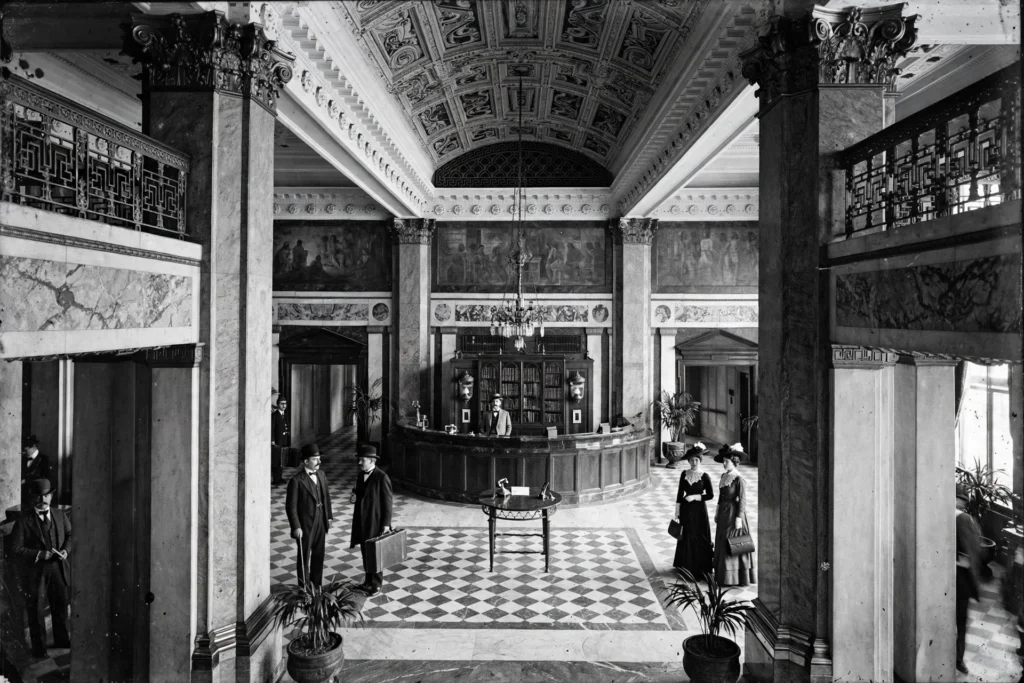
The French Renaissance style building, designed by architects W.J. Dodd and F.M. Andrews, featured lavish interiors. The finest materials such as marble from Italy, Germany, and France, and West Indies and European woods were used in its furnishings. Today, the Seelbach is included in the list of America’s Historic Hotels.
Gatsby’s Hotel and Capone’s Poker Room
The Seelbach’s most famous literary connection comes from F. Scott Fitzgerald, who spent time at the hotel in April 1918 while training for deployment during World War I. According to accounts of the visit, one night of expensive bourbon and cigars ended with Fitzgerald being restrained and ejected from the hotel. Whatever actually happened that night clearly stuck with him: he later used a hotel closely modeled on the Seelbach as the setting for Tom and Daisy Buchanan’s wedding in The Great Gatsby, cementing the hotel’s place in American literary history.
The Seelbach’s guest list only gets more colorful from there. During Prohibition, Al Capone was a frequent visitor, reportedly using the hotel for clandestine poker games. Hotel lore holds that during one such game, Louisville police broke things up, and Capone escaped through a network of secret stairways and tunnels built into the building. Capone’s favored room is even said to include two hidden doors behind wall panels leading to those passageways, and a large mirror he supposedly had shipped from Chicago so he could watch the door behind him while he played cards. Supposedly, a mirror still hangs in the hotel today.
Beyond literary and gangster history, the Seelbach has hosted a remarkable run of U.S. presidents over the decades, including William Howard Taft in 1911, Woodrow Wilson in 1916, Franklin D. Roosevelt in 1938, Harry Truman in 1948, John F. Kennedy in 1962, Lyndon B. Johnson in 1964, Jimmy Carter in the 1970s, Bill Clinton in 1998, and George W. Bush in 2002. It has been said that celebrities ranging from Whitney Houston and Elvis Presley to the Rolling Stones have stayed as well.
The Real Story Behind the Lady in Blue
The Seelbach has a ghost story that is particularly memorable for being associated with the real-life murder. The young woman named Patricia Wilson was found dead on July 16, 1936, hanging from the cable in one of the hotel’s elevator shafts. The woman was found dressed in a long blue dress and wearing her long, dark hair. The shaft was narrow, only four feet wide, and the only way to enter it was through the linen closet, which was a staff-only area.
There were many rumors about the mysterious circumstances surrounding the murder, but they were all dispelled by the 1955 True Detective magazine article titled “Bluegrass Justice for the General.” It told the story of the vengeful widow, claiming that the wealthy but washed-up Kentucky National Guard general Henry Denhardt argued with a young woman on the eighth floor of the hotel before the murder. Then, just outside in the hallway, a guest heard a commotion and a woman’s scream.
General Denhardt was never charged with Wilson’s murder; he was instead shot and killed by Wilson’s brothers before being brought to trial for her murder. Whatever happened on the night of the murder, the Seelbachs’ ghost story has been told over subsequent decades. According to the article, in 1987, a hotel cook named James Scott saw a young woman with long, dark hair walk into an elevator in a long blue dress as he was walking back to the room. In addition, a housekeeper claimed to have seen the same young woman walking into the elevator on the eighth floor shortly after Mr. Scott.
Lilac perfume has been reported by many guests and staff members to mysteriously fill the hotel’s halls, clinging to clothing and skin. It was also claimed to have been the scent that belonged to Patricia Wilson, who could still be seen by guests and staff who entered the elevator where she died. She is frequently described as touching the shoulder of whomever she encounters while riding in the elevator, and the Seelbach Hotel’s very own historian has been collecting stories of the Lady in Blue for years.
As with all good ghost stories, none of the strange happenings and sightings have actually been proven to be supernatural, and they should be taken with a grain of salt, despite the official recognition of the hotel’s history. The most notable difference between the Seelbach’s story and other made-up ghost tales is that the woman who haunts the hotel is real, and her murder mystery was never solved.
Frequently Asked Questions
Who was the real woman behind the Seelbach’s “Lady in Blue” legend? She’s identified in hotel and historical accounts as Patricia Wilson, a 24-year-old woman found dead in one of the hotel’s elevator shafts on July 16, 1936. The exact circumstances of her death were never conclusively resolved.
Is Al Capone’s poker room still part of the hotel? The hotel maintains that Capone’s favored room, along with its hidden panel doors and a mirror he reportedly had shipped in, still exists as part of the property today, though these details rely on lore preserved by the hotel rather than independent verification.
Did F. Scott Fitzgerald actually base The Great Gatsby’s hotel on the Seelbach? Fitzgerald spent time at the Seelbach in 1918, and literary historians widely accept that a hotel closely resembling it served as inspiration for the setting of Tom and Daisy Buchanan’s wedding in The Great Gatsby.
Visiting the Seelbach Today
More than a century after its opening, as a fitting prelude to the Kentucky Derby, the Seelbach Hotel in downtown Louisville remains open for business, providing its guests with an opportunity to follow in the footsteps of presidents, the Prohibition-era mobsters, and the writer of one of America’s greatest novels. According to dozens of witnesses, the woman in a long blue dress has never checked out.
The hotel embraces its duality, offering both guided historical walking tours of its architecture and its literary and political guests, and separate ghost-specific programming, including special evening tours, focused on the Lady in Blue and other alleged hauntings. It’s a fitting legacy for a building that has housed both residents of the presidency and the mob.
Have you stayed at the Seelbach or had an experience you can’t quite explain? Share it in the comments below.
Sources consulted for the historical details in this post include the Seelbach Hotel entry on Wikipedia, Historic Hotels of America’s history page for the Seelbach, Spectrum News 1’s coverage of the hotel historian’s research into the Lady in Blue, and The Bitter Southerner’s account of Fitzgerald’s time at the Seelbach.