The Case in Brief
Harriet Beecher Stowe in a parlor of her home next to Mark Twain’s in 1886. Credit: Harriet Beecher Stowe Center A Modest Cottage Next…
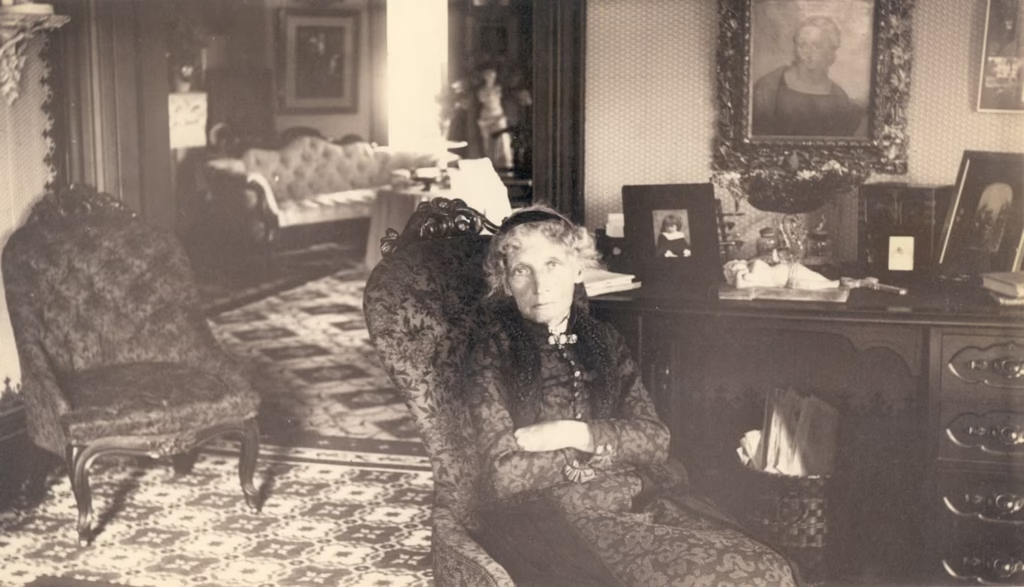
Harriet Beecher Stowe in a parlor of her home next to Mark Twain’s in 1886. Credit: Harriet Beecher Stowe Center
A Modest Cottage Next Door to Mark Twain’s Gothic Showpiece, Built by the Woman Whose Book Was Credited With Starting a War
Walk down Forest Street in Hartford’s Nook Farm, and you can’t help but think that, on either side of the fence, two very different people lived. On the corner stands the Mark Twain House, all sweeping porches and patterned brickwork, built to outshine his neighbors and proclaim his coming literary stardom. Next door and considerably less showy stands a gray cottage as much gabled as it is cramped that belonged to a woman whose novel has outsold every other book in human history save the Bible and sold millions more copies than any other single work of its era and whose fictional plea against slavery Abraham Lincoln supposedly credited with helping start the Civil War. Harriet Beecher Stowe lived in that cottage for the last twenty-three years of her life, finishing her last novel there, wandering her garden as her mind slowly evaporated, and dying in an upstairs bedroom in 1896. The ghost stories that have since accrued to her memory are comparatively tame when compared to those told about her neighbor’s footsteps and shifting shades rather than actual ghosts-but the history behind them, that can’t be said.
A Preacher’s Daughter Who Would Shake a Nation
Harriet Beecher was born in Litchfield, Connecticut, in 1811, the seventh of her parents’ children and the only surviving daughter (her mother, Roxana Foote Beecher, died when Harriet was five), of the fire-and-brimstone Congregationalist minister Lyman Beecher and his first wife. She was educated at the Litchfield Female Academy, a progressive institution that took it upon itself to teach girls not only history, astronomy, and Latin but also such “useless” arts as needlework, and in 1824, when she was thirteen, she went to live in Hartford to assist her older sister Catharine in running the Hartford Female Seminary, which Catharine had opened the previous year. Harriet remained in Hartford until 1832, when the family moved to Cincinnati, Ohio, so that her father could start a new seminary at Lane Theological School. (Across the Ohio River in Kentucky, slavery was legal; Harriet would venture into the slave South only once, for an extended visit to her sister in 1833.) She married Calvin Stowe, a professor of theology, in 1836, and for the next two decades, until the Civil War began, Calvin’s income as a minister and lecturer was never enough to support the large family, so Harriet not only took in boarders but also sold drawings and sketches to magazines that could afford to pay. “When I am getting out of the way of finishing anything,” she wrote to a friend, “it is like rowing against the stream.”
Grief, the Fugitive Slave Act, and the Book That Outsold Everything but the Bible
Stowe’s early abolitionist sentiments had found expression in a sketch written in 1845 about a fugitive slave hidden in a Cincinnati family home, a prelude to scenes she would describe in more details a few years later. Personal tragedy lent a new edge to her sensibilities. In 1849, as a cholera epidemic ravaged Cincinnati, Stowe’s infant son Charley died in her arms, and she later related that this grief taught her what a slave mother must feel when her child is ripped from her embrace by force. In the next year Calvin took a teaching position at Bowdoin College in Maine and the family moved once again, right around the time that Congress passed the Fugitive Slave Act of 1850, a new law which made it a federal offense to harbor or assist any escaped slaves anywhere in the United States, North, South, or otherwise. Stowe’s sister-in-law Isabella wrote to her, suggesting that she channel her talents as a writer into making everyone who read her work keenly aware of the moral dimensions of slavery, and Stowe took that charge to heart, submitting a proposal for a series of sketches to the abolitionist magazine the National Era. Serialized in that magazine through 1851 and 1852 and then released in book form as Uncle Tom’s Cabin, the novel became the best-selling book of its day anywhere other than the Bible, spawned more than twenty rival stage adaptations in London in its first three years, and was the subject of a legend told throughout the next century.
A Legacy the Author Herself Complicated
Uncle Tom’s Cabin gave abolitionism a tremendous boost, but the black Americans it portrayed had a more ambiguous legacy than the book’s huge sales ever suggested. Stowe herself wrote in her 1853 nonfiction sequel A Key to Uncle Tom’s Cabin that she thought black Americans “were, on the whole, a more simple, docile, loving, and childlike people than the race to which I belong,” a judgment modern scholars are likely to call a variation on the Romantic racism that pervaded American culture: holding that black Americans were morally superior to white Americans but still categorically different. Solomon Northup’s 1853 slave narrative, Twelve Years a Slave , deliberately complicated Tom’s meek and patient demeanor, arguing that anyone who had spent enough time with actual slaves and listened closely enough to their thoughts would realize they were just as smart and just as eager for freedom as anyone else. Twentieth-century black writers were among those most profoundly affected by the book. “Everybody’s Protest Novel” (1949), a searing essay by James Baldwin, accused Stowe of exploiting the same melodramatic histrionics that allowed her readers to indulge their humanitarian impulses while avoiding the messy moral ambiguities of the real world; meanwhile, Richard Wright, whose Uncle Tom’s Children(1938) was a debut story collection originally intended to be called simply Uncle Tom’s Children , later came to regret the association, arguing that it had helped make his work palatable to rich banker’s daughters who might otherwise never have picked it up — Wright’s subsequent Native Son (1940), a far darker and more ambiguous novel, was deliberately written so no one would ever again be able to read it the way they did Uncle Tom’s Cabin .
From an Eight-Gabled Folly to a Modest Cottage on Forest Street
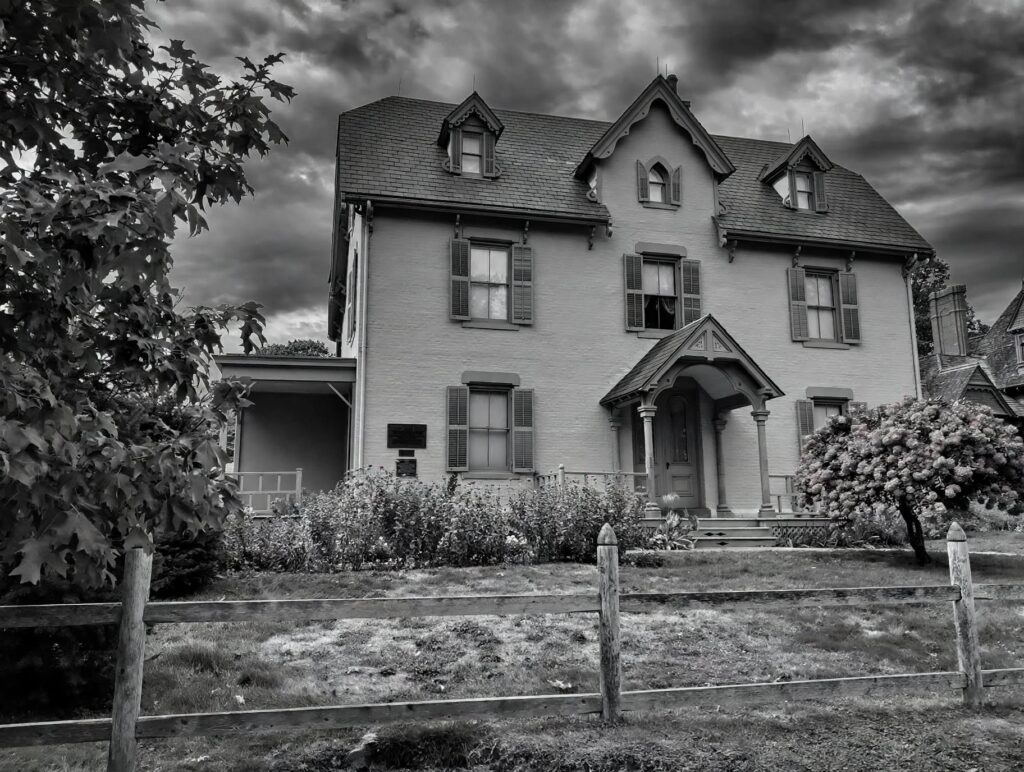
When Stowe returned to Hartford for good in 1864, her first home was Oakholm, an elaborate Gothic Revival villa that she designed herself, inspired by the home decorating principles she began laying out in her House and Home columns for the Atlantic Monthly. Oakholm was impressive and largely lived up to almost none of her own advice-the rambling eight-gabled house was drafty and too expensive to heat, and in 1873 Stowe and Calvin moved into the much more modest dwelling on Forest Street that survives today. The district, known as Nook Farm (the name derived from a bend, or nook, in the river that formerly bounded the area), was developed by the lawyer John Hooker and the politician Francis Gillette into an enclave of writers and reformers. Stowe’s own half-sister, the suffragist Isabella Beecher Hooker, had a home nearby; so did the Hartford Courant editor and novelist Charles Dudley Warner, the actor William Gillette, and, in the ornate new house being built next door, Samuel Clemens. Stowe had explicitly warned, in the home management book she coauthored with her sister Catharine, The American Woman’s Home, against the clutter of superfluous curlicued ornament she mockingly names (decoration that costs money and makes a house neither prettier nor more comfortable)-a critique that one suspects she could not help but keep in mind when Twain’s considerably more ornate showplace went up next door.
Life Next Door to Twain
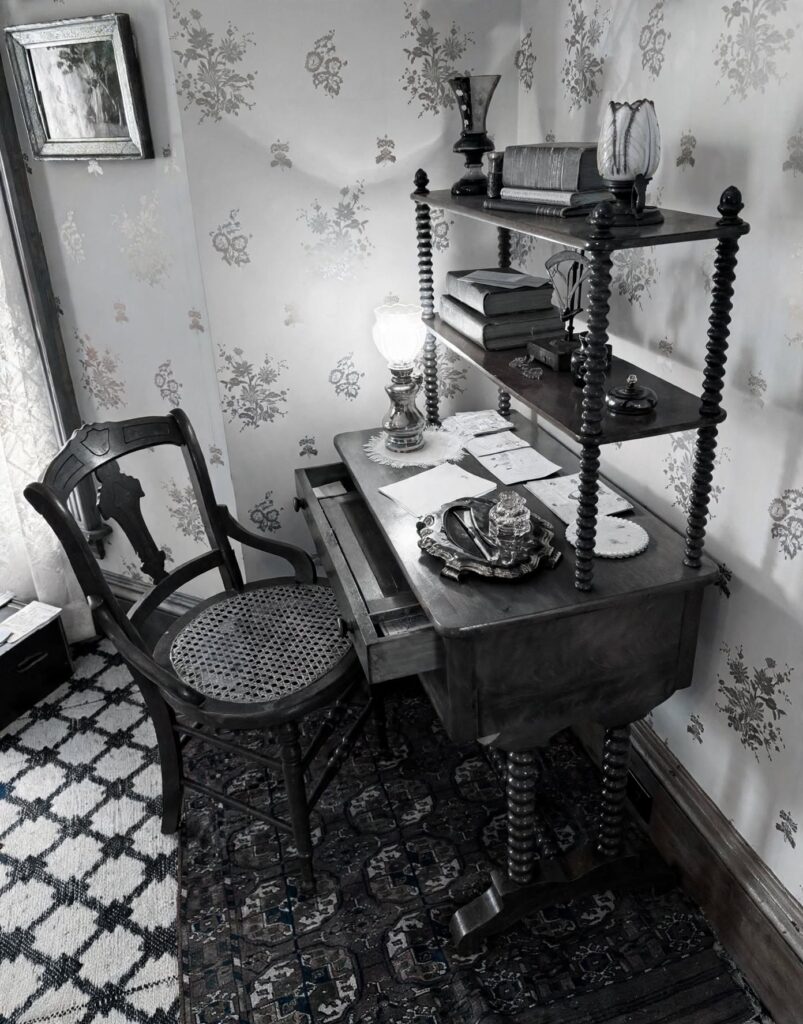
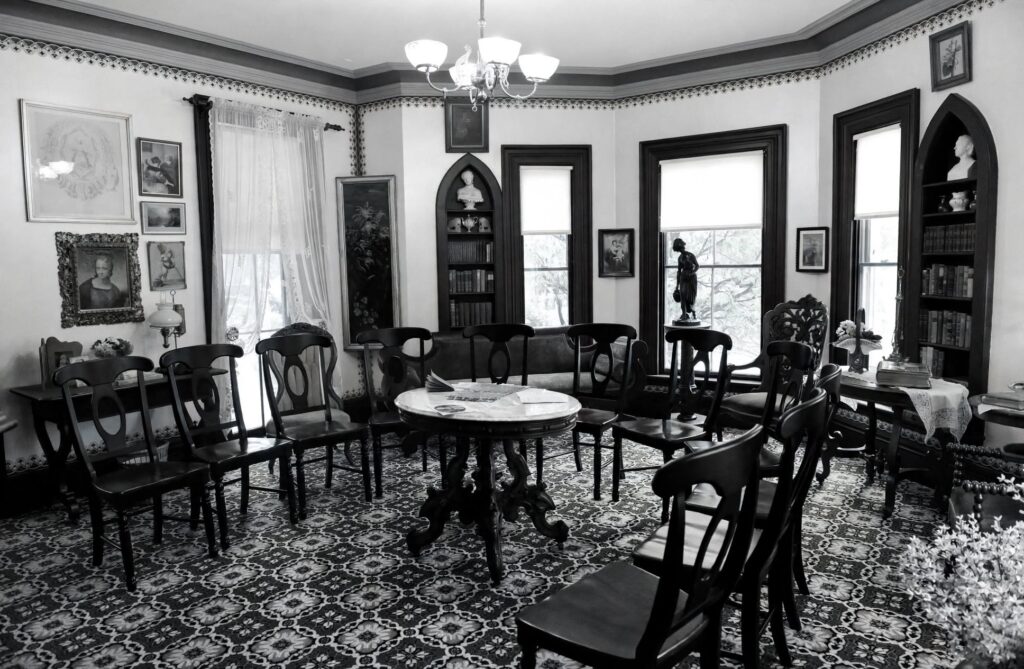
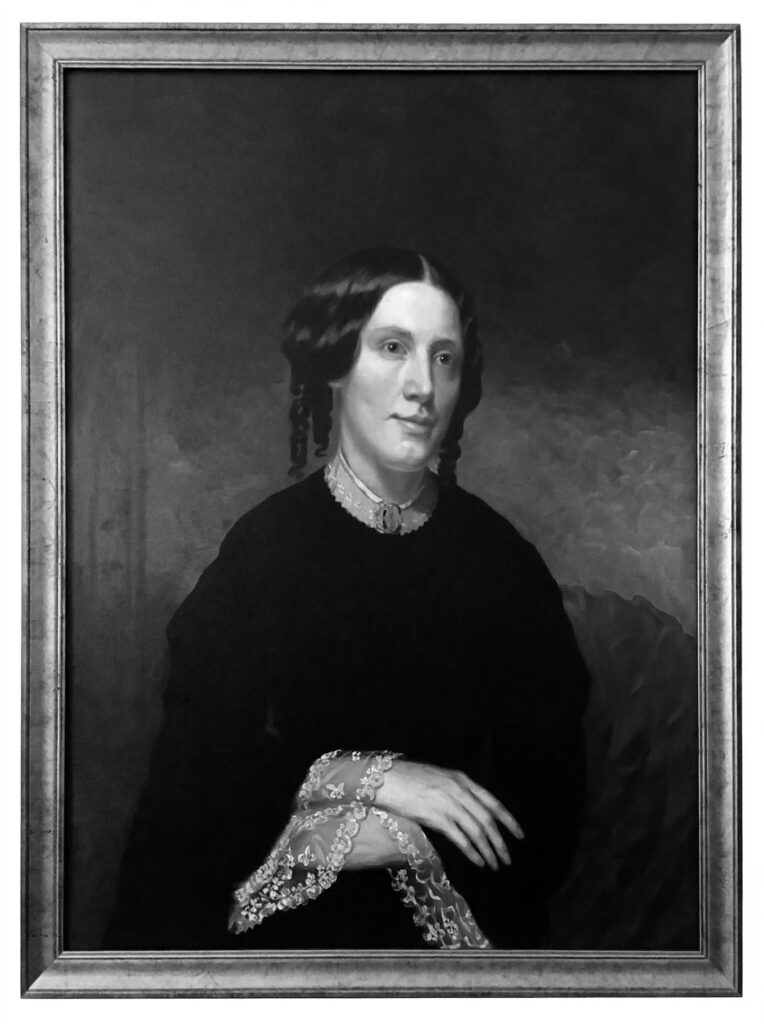
Inside, Stowe made good use of her design philosophy: mingling the harmonious color schemes of her magazines, light-filtering ferns and plants in place of heavy drapes, easy-care rush mats in place of thick Victorian carpets, and inexpensive art reproductions, including one of Raphael’s Madonna, along with her own paintings. Twain, for his part, built the conservatory on his own house using principles borrowed directly from her plan. It was in this house that Stowe completed her last novel, Poganuc People, which she based on her own Connecticut childhood, as well as Palmetto Leaves, Betty’s Bright Idea, and several other later books. A journalist who visited in 1885 described Stowe as a quiet, plainly-dressed woman given to long periods of reverie, a practice that allowed her to continue writing even in the face of domestic interruptions that would stop up short of most writers; when she mentioned that she could no longer say precisely how long she had been in Hartford, Twain, having heard it secondhand, said he wished the tax collector would adopt the same principle. The same visit took a dark turn when Stowe related the hate mail Uncle Tom’s Cabin had engendered at the height of its popularity, including one letter that famously came by mail with a severed human ear enclosed inside. Calvin Stowe, meanwhile, was captured in an 1852 portrait he asserted was the only one that was worth keeping, relating to a visitor of it, “That is the way she will look at the resurrection.”
A Fading Mind and a Familiar Yard
Stowe’s last years in the house were defined by a gradual descent into a state of mental confusion that friends and neighbors managed to avoid confronting directly. She would stroll around the neighborhood picking wildflowers absentmindedly and more than once she wandered into Twain’s yard on the next door lot picking bouquets of flowers growing right there, a sufficient nuisance that the family supposedly even hung up pairs of scissors around the house as reminders not to break plant stems while picking blossoms. She died in the house in 1896, with her half-sister Isabella Beecher Hooker, the same Nook Farm neighbor who’d helped found the community decades earlier, at her side. Two of Stowe’s daughters, Eliza and Hatty, had lived in the house with her for years and wanted to keep it in the family, but the unfavorable royalty contracts Stowe had signed decades earlier meant that Uncle Tom’s Cabin, for all the millions of copies it would eventually sell, had never been much of a financial legacy.
Saved by Her Own Family, Twice Over
The house passed out of the family’s hands until 1924, when Stowe’s grandniece, Katharine Seymour Day, bought and began restoring it, eventually founding the Stowe-Day Foundation. Day’s name will be familiar to anyone who read about the house next door;she is the same preservationist who, five years after purchasing Stowe’s house, launched the campaign that saved the Mark Twain House from demolition, meaning the two neighboring landmarks on Forest Street are both the result of the same woman’s determination. The organization Day founded changed its name to Stowe Center for Literary Activism in 1941, fully restoring the house between 1965 and 1968 before unveiling it to the public in 1968. It was recognized on the National Register of Historic Places in 1970 and designated a National Historic Landmark in 2013.
Why Visitors Call It Haunted
Compared to the more elaborate, multi-entity legends that surround certain of the other houses on this site, the Stowe House’s haunting phenomena are relatively understated, not as showy as one might expect. Visitors and staff have reported window shades in the parlor opening on their own, hearing footsteps echoing around empty rooms, and seeing flashes of unexplained light emanating from the upstairs bedrooms, with at least one ghostly figure reportedly sighted in the visitor’s center building. A televised exploration by the paranormal series Ghost Hunters claimed to have captured what their onsite crew described as a handful of unexplainable spirit voices during their visit, though independently maintained listings tracking the house’s reputation note that substantive, verifiable encounter reports are comparatively thin on the ground for this particular location compared to its far more famous neighbor. It is interesting to note that spiritualism itself was not a stranger to this particular corner of Nook Farm; Isabella Beecher Hooker, the half-sister who sat with Stowe when she died, was herself a well-documented spiritualist in her own right, involved in the movement partially through her connection to the medium and activist Victoria Woodhull, meaning that whatever quiet residuum of psychic energy visitors might feel in Stowe’s house today, it was standing right next door to somebody who had embraced the idea of contacting the dead with all her might while Stowe was living there.
Visiting the Harriet Beecher Stowe House Today
The Stowe Center for Literary Activism is open Wednesday from 10:45 a.m. to 5 p.m. and Thursday through Saturday from 9:45 a.m. to 5 p.m., closed Sunday through Tuesday as well as Juneteenth, Thanksgiving, and Christmas. The standard Inspiring Stowe tour takes about 60 minutes and includes the museum’s Gallery for Literary Activism, with a shorter 30-minute Writing Freedom tour also available, plus group tours by arrangement. General admission runs $20 for adults, with discounts for seniors, students, and children, and a $15 self-guided audio tour includes a walk through the wider Nook Farm neighborhood, including the Mark Twain House next door. Anyone contemplating a literary pilgrimage to Hartford can see both Forest Street landmarks in one trip, one a Gothic showpiece meant to announce a fortune, the other a modest cottage that outlives a fortune’s dissipation and helps redefine a nation.
Does knowing that Stowe’s own royalties never purchased the house for her family that Uncle Tom’s Cabin purchased for her place in history, change the way one reads its comparatively staid hauntings? Or does a house so steeped in real sorrow, real controversy, and a next door neighbor’s very own spiritualist convictions not need dramatic ghost stories to make it worth visiting? Let us know in the comments below.
Sources consulted for the historical details in this post include Shelley Fisher Fishkin, “The House That Uncle Tom’s Cabin Bought: Harriet Beecher Stowe House, Hartford, Connecticut,” in Writing America: Literary Landmarks from Walden Pond to Wounded Knee (A Reader’s Companion), Rutgers University Press (2015), pp. 93–111; George Parsons Lathrop, “[Stowe at Nook Farm],” in Stowe in Her Own Time: A Biographical Chronicle of Her Life, University of Iowa Press (2009), pp. 188–192; the Wikipedia entry on the Harriet Beecher Stowe House; the Stowe Center for Literary Activism’s own visiting information; Connecticut History’s and Wikipedia’s entries on Isabella Beecher Hooker; Women’s History Blog’s account of Isabella Beecher Hooker’s involvement in spiritualism; and HauntedPlaces.org’s and CT Haunted Houses’ listings of reported paranormal activity at the Stowe House.