The Case in Brief
A Fortress Built to Fix the Soul Through Silence Soaring over Fairmount Avenue like a medieval castle dropped into the middle of downtown Philadelphia, Eastern State Penitentiary…
A Fortress Built to Fix the Soul Through Silence
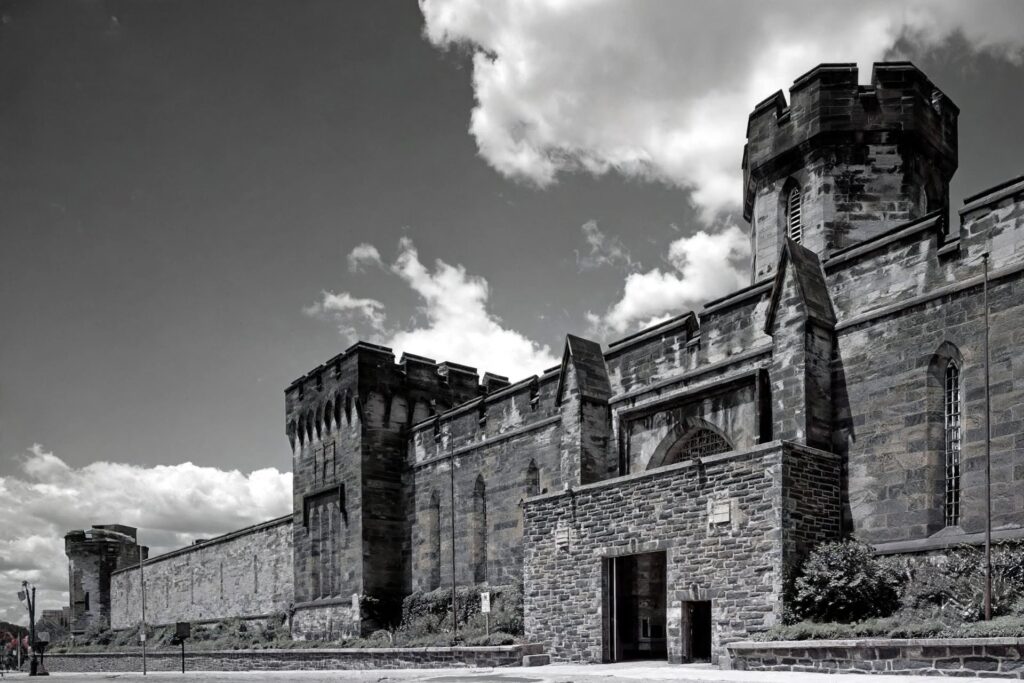
Soaring over Fairmount Avenue like a medieval castle dropped into the middle of downtown Philadelphia, Eastern State Penitentiary was never meant to be a pretty prison – and it isn’t. Thirty-foot-thick stone walls, guard towers, and a Gothic Revival gatehouse were built in the 1820s to make it clear, even before you could see the prisoners, that this was an institution dedicated to reforming criminals through total isolation and total silence.
Once the most famous prison in the world, it was so revolutionary that European governments came to visit, and so intimidating that it drove some of its inmates to madness. It held Al Capone for seven months, witnessed twelve prisoners tunnel their way out in 1945, and was ultimately abandoned by the city of Philadelphia after two decades of sitting empty, its cellblocks swallowed by trees and ivy. Now it attracts a different kind of visitor than the reformers who designed it ever intended – not to contemplate their sins, but to wonder if something was lost in those silent cells that never found its way out.
Founding a Machine for Making Penitents
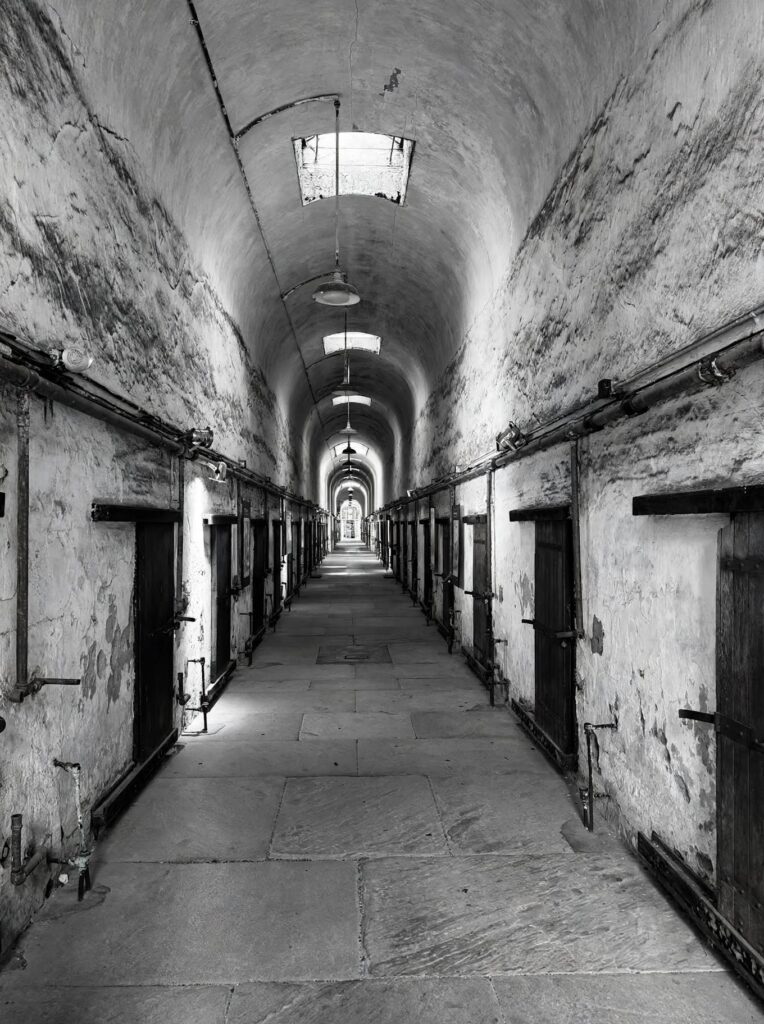
Eastern State Penitentiary is the creation of the Philadelphia Society for Alleviating the Miseries of Public Prisons, a Quaker-dominated reform organization that found the corporal punishment prevalentat places such as New York’s Auburn prison both cruel and unproductive.
The method they advocated, developed in the years of prison reform that followed the turn-of-the-century imprisonment of Roberts Vaux, came to be known as the Pennsylvania System or separate confinement: rather than forcing inmates to labor in groups under the ever-present threat of the whip, each prisoner would be placed in solitary confinement, assigned work to keep his mind off his misdeeds, and provided with religious instruction to rehabilitate his soul, and, the reformers were convinced, that would be sufficient to create a truly reformed man when release day arrived.
The doctor Franklin Bache summed up the intent behind the design in a report written in 1831, when he noted that the idea was to use solitude to lead the inmates to a life of penitence.
John Haviland, the architect who designed Eastern State, submittedhis plans for the prison in 1822, a radical hub-and-spoke design that placed a central observation rotunda at the prison’s core and hadcellblocks radiating out from it like spokes on a wheel, allowing a single watchman to see all the prisoners from his post.
Construction began in 1823, and the cornerstone was laid in 1829, but long before its completion, on October 25, 1829, the first prisoner, a farmer and burglar named Charles Williams, was received into its still-unfinished walls.
The System of Total Silence
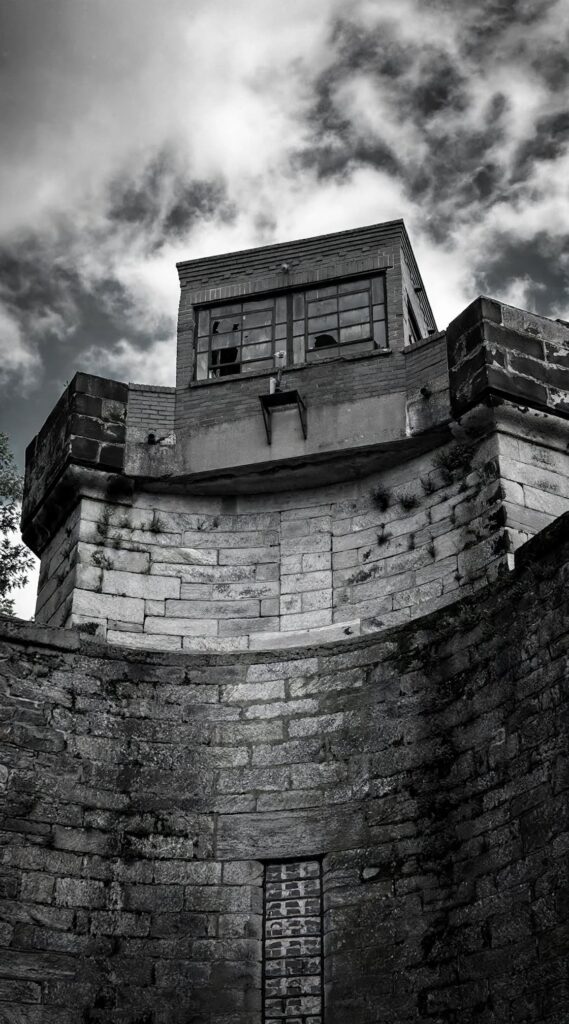
The design of separate confinement was total by intention. Each prisoner was led into the penitentiary hooded, so he could never learn the lay of the building or recognize another’s face, and was taken to a private cell with its own small yard for exercise, so that in theory he need never see or speak with another human being beyond his keepers for the length of his sentence.
Warden Samuel Wood, the penitentiary’s first administrator, spelled out the reasoning behind the isolation in a direct statement, sayingthat its purpose was to turn a convict’s thoughts inward upon himself and teach him how to think. British penal reformer William Crawford, sent by his government in 1833 to investigate the American system, left convinced that Philadelphia’s method was gentler than Auburn’s in every way, noting that the whip degraded a man, while solitude merely subdued him.
Not all visitors left as impressed. Charles Dickens toured the penitentiary on his famous American lecturing tour in 1842 and left one of the most quoted blasts against prison life in the literature of reform, denouncing what he saw as the psychological cruelties of the system as “this slow and daily tampering with the mysteries of the brain,” a far harsher judgment than the institution’s Quaker founders intended their creation to suffer.
When Theory Met Reality
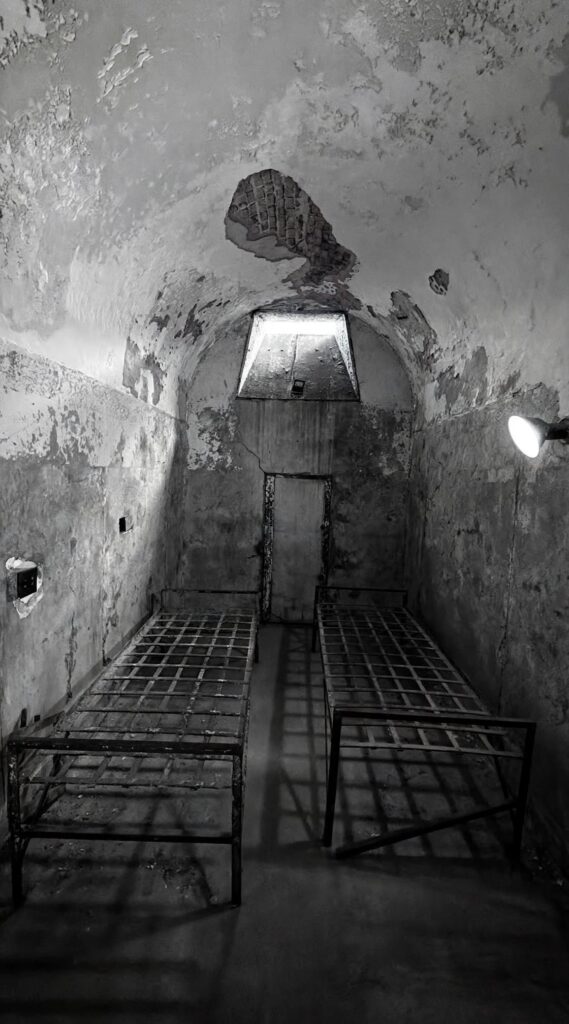
The distance between the reformers’ intentions and the reality of the roughly three hundred men and women confined at Eastern State during its first five years proved to be considerable, according to the wardens’ and physicians’ own records, rather than the carefully crafted reports the Philadelphia Society issued to the public each year.
Solitary confinement, for all its promise, did not always lead to introspection; some prisoners who violated the rules forbidding communication with adjacent cells by tapping on pipes, and shouting through vents. They were subjected to punishments their very founders had sought to banish from Eastern State, namely those used at Auburn.
Among the various restraints employed on difficult inmates duringthe penitentiary’s early years were the straitjacket, the iron gag, and a device called the Mad Chair, a chair fitted with straps tight enough to cut off circulation, developed in part from theories of the physician Benjamin Rush.
Disease spread throughout the isolated cells as readily as in any crowded institution of the period, and the surviving physicians’ logs reveal prisoners who did not survive their sentences at all, thus belied the reformers’ rosy statistics on the system’s low rate of recidivism.
Visited by a Skeptic
Eastern State was famous internationally from the moment of its founding, attracting a steady stream of foreign visitors who came tosee and judge the American experiment for themselves. Among them in 1831 were the French magistrates Alexis de Tocqueville and Gustave de Beaumont, sent by their government to survey American penitentiaries before Tocqueville would go on to greater fame Democracy in America.
Their official report on the American prison system made Eastern State the model of the separate system in the United States, against which every other American prison and,eventually, several European ones would be measured for the next two decades. England and France both briefly adopted the Pennsylvania System, in the 1840s and 1850s, respectively, before giving it up as impractical, but for a while the citadel on Fairmount Avenue really was the most studied prison in the world.
The Mystery of the Missing Cornerstone
Even the building’s own founding has a loose thread that historians have never fully tied off. The cornerstone laid with appropriate ceremony in 1823, inscribed to commemorate the penitentiary’s founding, went missing at some point over the following century, and by the time historian Negley K. Teeters researched the institution’s early history in the late 1940s, no one on staff could say what had happened to it or where it had gone.
Teeters’s research also turned up one of the stranger surviving images connected to the penitentiary’s history: an old photograph, found tucked away in one of the building’s inner reaches, showing a warden posed in the black hood that was once forced over every incoming prisoner’s head, an image with no clear explanation for why it was taken or preserved at all.
Al Capone’s Cell and the Great Tunnel Escape
Eastern State’s most famous inmate never intended to stay long, and didn’t. Al Capone was arrested outside a Philadelphia movie theater in May 1929 on a weapons charge and sentenced to a year at Eastern State, of which he served roughly seven months before his release in March 1930 for good behavior.
Newspaper accounts of his cell contradicted each other almost immediately, with one early report describing tasteful paintings and a powerful cabinet radio receiver and a rival paper insisting the following day that his accommodations were perfectly ordinary and shared with another inmate.
What is well documented is considerably stranger than the furniture: Capone reportedly spent part of his time at Eastern State visibly disturbed by something only he could perceive, at one point begging a presence he addressed as Jimmy to leave him alone, a name some researchers have connected to a victim of the 1929 Saint Valentine’s Day Massacre Capone was believed to have ordered.
Fifteen years later, on April 3, 1945, a considerably more organized escape attempt played out beneath the same walls. Twelve inmates, led by the bank robber Willie Sutton and a plasterer named Clarence Klinedinst, known to the other inmates as Kliney, spent months digging a tunnel roughly a hundred feet long and twelve feet deep from a cell in Cellblock 7, complete with electric lighting and a connection to the prison’s own sewer system for ventilation.
The escape itself was almost anticlimactic: Sutton was recaptured within minutes of surfacing, and every escapee was back in custody within months, but the tunnel’s sheer ambition made it one of the most studied prison breaks in American history, so much so that archaeologists used ground-penetrating radar to relocate its remains in 2005.
Decline, Abandonment, and Rebirth
By the mid-twentieth century, the separate system Eastern State had been built to pioneer was long since abandoned in practice, and the aging, overcrowded facility could no longer function the way its 1829 design had intended. The Commonwealth of Pennsylvania closed it as a state prison in 1970, after a brief final stint housing county prisoners in 1971, and then simply walked away.
For nearly two decades afterward, Eastern State sat empty in the middle of a major American city, its cellblocks colonized by feral cats, its stone corridors sprouting trees and ivy through collapsed roofs, an urban ruin large enough to swallow a city block. Stabilization funded by the Pew Charitable Trusts began in 1991, and the site reopened to the public as a historic tour in 1994, initially offering little more than hard hats and flashlights through the still-crumbling ruin.
It had already been designated a National Historic Landmark in 1965 and added to the National Register of Historic Places the following year, protections that helped ensure the ruin was preserved rather than demolished during its emptiest years. Today the site draws roughly 220,000 visitors annually, deciding to save it rather than raze it look, in hindsight, like one of Philadelphia’s better bets.
Why Visitors Call It Haunted
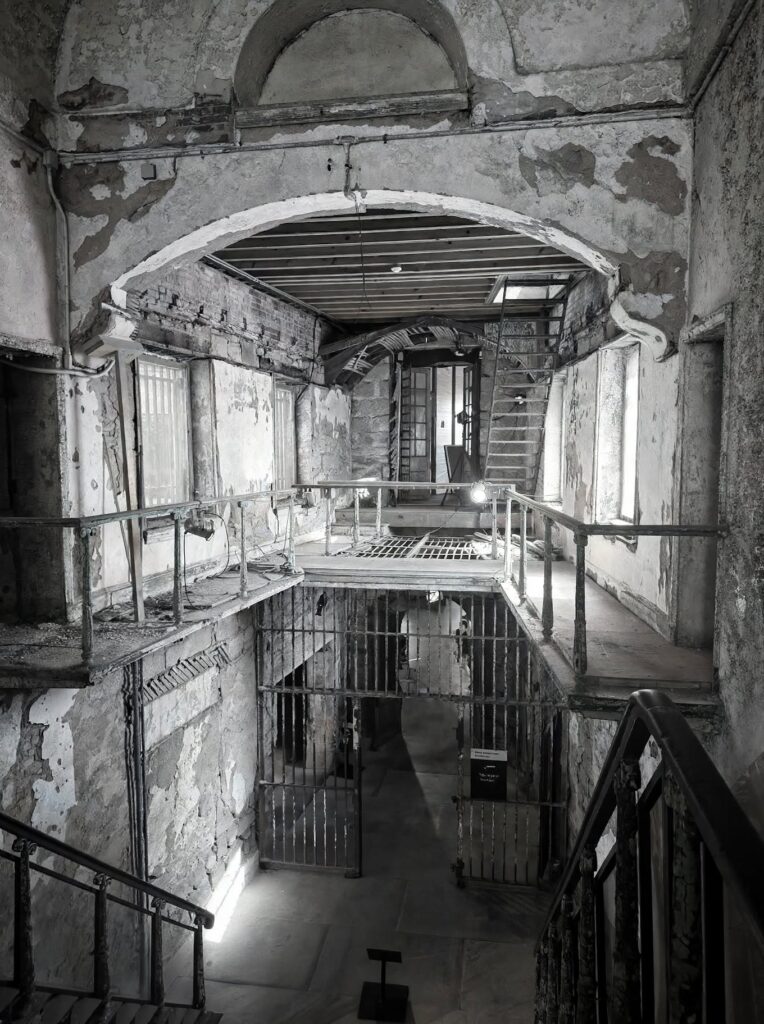
Eastern State’s reputation as one of America’s most haunted sites has made it a fixture on paranormal television, with crews from Ghost Hunters, Ghost Adventures, and MTV’s Fear all filming inside its walls over the years. The Ghost Hunters crew reported capturing what appeared to be a full apparition of a man walking through Cellblock 12, footage that remains one of the site’s most frequently cited pieces of evidence.
Staff and visitors have separately and repeatedly reported a woman in white seen sitting in the last cell on the second floor of the former women’s wing, a figure well-known enough among the staff to have earned her own nickname, the Soap Lady. Whispering, giggling, and quiet weeping have all been reported echoing through empty cellblocks with no identifiable source, and multiple guests over the years have described seeing a man standing watch in one of the old guard towers, a claim made stranger by the fact that the brick stairs leading up to it crumbled away and physically disappeared decades ago.
Even Capone’s reported distress has become part of the site’s lore in its own right: some later paranormal investigators have connected his Jimmy episodes to the same restless energy visitors report today, a haunting that, if the stories are to be believed, may have started following one of its most notorious residents around even after he walked free.
Visiting Eastern State Penitentiary Today
Eastern State Penitentiary is open daily from 10 a.m. to 5 p.m. during peak season, with select winter weeks running Wednesday through Monday on the same hours; it closes for New Year’s Day, Thanksgiving, Christmas Eve, and Christmas Day.
Self-guided audio tours, narrated in part by actor Steve Buscemi, walk visitors through the cellblocks, Al Capone’s restored cell, and the remains of the 1945 escape tunnel, with guided and behind-the-scenes tours also available by ticket.
Every October and November, the site transforms into Halloween Nights, the rebranded successor to the long-running Terror Behind the Walls haunted house that has operated on the grounds in some form since 1991, combining historic tours with staged haunted-house scares, themed bars, and live entertainment on select evenings.
Current ticket prices and specific tour times are available through the site’s own ticketing page, and given the crowds the Halloween season draws, advance tickets are worth buying well ahead of an October visit.
Does knowing that Eastern State’s founders genuinely believed silence and solitude were acts of mercy change how you read the voices, footsteps, and half-glimpsed figures visitors still report inside its walls today, or does a building that broke as many minds as it claimed to reform not need embellishment to feel like the most unsettling place in Philadelphia? Let us know in the comments below.
Sources consulted for the historical details in this post include Negley K. Teeters, “The Early Days of the Eastern State Penitentiary at Philadelphia,” Pennsylvania History: A Journal of Mid-Atlantic Studies, Vol. 16, No. 4 (October 1949), pp. 261–302; Jacqueline Thibaut, “‘ To Pave the Way to Penitence’: Prisoners and Discipline at the Eastern State Penitentiary 1829–1835,” The Pennsylvania Magazine of History and Biography, Vol. 106, No. 2 (April 1982), pp. 187–222; the Wikipedia entry on Eastern State Penitentiary; Eastern State Penitentiary’s own historic site and hours-of-operation pages at easternstate.org; the Smithsonian Magazine account of the 1945 tunnel escape; Oxygen.com’s account of Al Capone’s incarceration at Eastern State; and Ghost City Tours’ listing of reported paranormal activity at the site.