The Case in Brief
Ask anyone to name a “most haunted” location near them, and there’s a good chance the answer is a former psychiatric hospital. Waverly Hills.…

Ask anyone to name a “most haunted” location near them, and there’s a good chance the answer is a former psychiatric hospital. Waverly Hills. Danvers State. Trans-Allegheny. Pennhurst. Across the U.S., the U.K., and beyond, the abandoned asylum has become the single most reliable setting in paranormal culture. They are more common than graveyards, more iconic than plantation houses, practically synonymous with the genre itself. Ghost-hunting shows return to them again and again. Haunted attractions build entire seasonal businesses inside their crumbling wards. If you’ve spent any time in this hobby, you already know the pattern.
What is less often asked is why. Why this particular group of buildings, rather than nearly any other type, came to be so intrinsically linked to ghost stories. It is not just psychiatric hospitals that get associated with the supernatural, but also TB sanatoriums, hospitals, or other large-scale medical institutions of the past that were closed and turned into ghostly hospices. Why is this the case, and what is the history behind such an occurrence? The most interesting part is that it concerns architecture that was deliberately designed to be the opposite of inviting. It had a dark role in history as an instrument of death and a destroyer of lives. Hundreds of such buildings around the country were abandoned for anyone to gaze upon, and the process of transforming them intoentertainment venues took decades. Knowing this history is essential to truly experiencing such a place, as it makes the very idea of haunting more frightening than a mere fictional specter ever could.
Buildings Designed to Heal, Not to Haunt
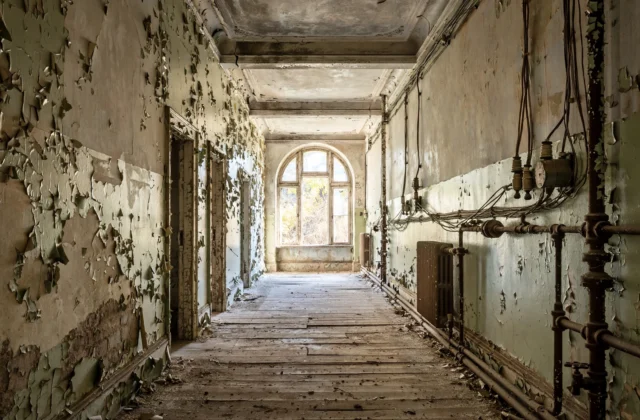
Here is the detail that will surprise most people: the buildings associated with horror were initially designed according to an optimistic and reform-minded theory of mental health treatment. Starting in the mid-19th century, American psychiatrist Thomas Story Kirkbride developed the so-called Kirkbride Plan, a uniquearchitectural model that was geared towards implementing “moral treatment.” The plan was innovative for its time, and it could genuinely improve patients’ wellbeing. The asylums built on its foundation between 1848 and the end of the nineteenth century were characterized by their use of natural light and space, oftenarranged in a particular staggered, winged manner, to ensure that each ward was sunny and airy (Pérez-Fernández & López-Muñoz, 2019). They were designed to be humane, as compared to the dark and stuffy madhouses they replaced.
The scholar Bridget Franklin examines this development in detail: the asylum is the product of the same social and civil relations that define “how madness was thought best dealt with in the nineteenth century,” and it “was built on an unprecedented scale by the bestarchitects of the age” (Franklin, 2002, p. 8). Note that asylums were not utilitarian institutions; they often stood out as the largest andmost elaborate buildings in their region. Their architectural grandiosity and beauty often survived the test of time, outliving many other buildings constructed during the same period.
From Moral Management to “The Asylum of Terror”
But in what way were these buildings that were created in pursuit of light, air and reform made universal symbols of horror? According to Franklin’s research, the reason is simple: during some time, the particular building with Kirkbride architectural stylebecame a symbol of horror and was abandoned (Franklin, 2002). There are several reasons behind such a situation, and they are both economic and theoretical. Moral treatment was graduallyabandoned, and other methods appeared and were widespread. As a result, mental hospitals were forced to close down becauseof the lack of funds: those buildings that were once the center of architectural modernism were abandoned, became dilapidated and eventually demolished. Such a tragic end happened to those buildings because they first seemed good and progressive, and they were quickly adopted: as a result, their active use shortened their natural lifespan.
It is this gap between closure and repurposing that forms the basis of modern haunted-asylum reputation. Thus, Pérez-Fernández and López-Muñoz in their 2019 research analyzing Kirkbride buildings’ cultural history from 1850 to 2015, revealed that at least 25 of the original buildings were preserved long enough to be granted a status of protected historic sites, and that during these periods“surrounded by a legendary aura, these buildings have become a leitmotif of contemporary popular culture: the asylum of terror”(Pérez-Fernández & López-Muñoz, 2019). In other words, it is a documented and traceable shift in the symbolic representation of these particular buildings, from a moral-treatment showpiece, to an embarrassing remnant of the discredited system, and to the horror-movie set piece, over the span of approximately a century and a half.
It’s Not Just Asylums
While psychiatric hospitals are the most prominent fixtures in the annals of paranormal lore, they are not the only type of institutional establishments that are frequently chronicled ashotbeds of ghostly activity. In fact, tuberculosis sanatoriums the isolation hospitals where TB patients were confined prior to the development of effective antibiotics follow a very similar progression of events, and examining one can provide valuable insight into the general trends of these places.
Take the example of Sanatorio Carlos Durán Cartín in Costa Rica, which has been one of the best-documented examples in the mostrecent architectural-heritage literature. Established by physician Carlos Durán Cartín in 1915 and opened in 1918, this hospital wasthe first in Central America to specialize in the treatment of tuberculosis, incorporating American sanatorium architecture thatdirectly inspired its construction (Sibaja Matamoros & Garzulino, 2024). Like Kirkbride asylums, this hospital was built around a trulyforward-thinking medical philosophy for the time: segregatingcontagious patients, exposing them to fresh air and sunlight, and giving the disease breathing room to fight, rather than to simply suffer. The complex expanded throughout the 1930s as treatments were developed to combat tuberculosis, but it began to decline in the 1940s as new urban hospitals opened and antibiotics made large-scale isolation sanatoriums less necessary.
The institution was closed completely in 1973. What happens next will sound familiar to you: instead of being destroyed or turnedinto another structure, it was used as a juvenile detention center until 1990. After that, there is no clear evidence of what happened to the building; it was simply abandoned and left to decay for more than two decades. It wasn’t until 2014 that the building wasrecognized as Costa Rican cultural heritage, as it represented a “tangible testament” of a particular chapter of medical and architectural history, but it was also marked as a building in direneed of preservation (Sibaja Matamoros & Garzulino, 2024). Today itis one of the most popular destinations for reputedly haunted ghost hunters and dark-tourism enthusiasts, with visitors coming from well outside of Costa Rica.
Notice the pattern: progressive design, a period of time during which the hospital was operated and patients suffered, a reason why it stopped being used, years or decades of abandonment, and then a slow reclamation as either a heritage site, a horror attraction, or both. This is more or less the same pattern that Franklin (2002) and Pérez-Fernández and López-Muñoz (2019) describe for Kirkbride asylums. Not unique to psychiatric institutions, this pattern is typical formany large-scale purpose-built hospitals that ceased to serve their original function.
The old hospitals and asylums are put on the same haunted-lists dueto their architectural peculiarities, and not due to the type of patients that they used to host. However, concerning institutional hospitals, they usually stop being used due to their progressive design, and not due to any specific treatment that they pioneered. It could be a psychiatric condition that was finally cured, thereby, making the hospital obsolete, or it could be a new and better hospital built nearby that makes the old one redundant. Either way, the reason why the hospital is abandoned is architectural, not clinical.
Real Suffering Behind the Reputation
It is essential to recognize that the buildings were disreputablefor a reason. Many of these establishments were places wherepatients were submitted to mistreatment. After moral treatment was abandoned and replaced with overcrowding, neglect, and, in many institutions’ case, outright abuse, they acquired a lastinglegacy of suffering. The legacy often lived on long after thefacilities had closed down. This is why the scholars of dark tourism refer to them as “negative heritage,” a term that encompasses all of these places’ troubled legacies that have to be grappled with nonetheless.
Heidi Aronson Kolk’s analysis of the haunted history tour industry practices in the U.S. provides insight into the phenomenon. Her research aims to demonstrate that such tours, as they arecurrently operating in St. Louis, New York City, and Savannah, among other locations, are not merely commercial enterprises. Rather, they utilize ghost lore and seek to address problematic histories that may have been ignored or overlooked.
Based on the author’s research, one can assume that the use of ghost tours and the folk beliefs that are used in them is a kind of informal historiography. It provides the audience with the ability to get to know the events and places that the official history would like to erase or pay much attention to.
That’s a generous reading, and it’s not the whole picture. It’s also true that turning a site of real institutional trauma, including the suffering of people who had no choice about being there, into a haunted attraction can flatten and sensationalize that history, trading nuance for scares. Both things can be true simultaneously: a former asylum can be a legitimate site of historical reckoning and a place where marketing has leaned hard into shock value. Worth keeping in mind on your next investigation is which one you’re actually engaging with, and whether the presentation in front of you treats the people who lived and died there as history or as set dressing.
How the Ghost Stories Actually Get Built
There is also a more mechanical reason why certain buildings, asylums in particular, are more likely to accrue ghost stories than others, it involves the very nature of story propagation. According to the article, recent studies conducted by Rachael Ironside and Fiona Smith demonstrated that “spectral geographies” the processes by which particular locations get labeled as haunted have significantly affected the popularity of ghost stories, with websites and other media promoting such tales being crucially important in the creation of a “haunted” perception of a certain place, rather than a tragic one. In their article, the authors discuss how the phenomenon of ghosts, hauntings, and the supernatural ingeneral is inextricably linked to the places of death and tragedy, as well as the culture and subculture surrounding them, which has seen a significant increase in the past two decades, with the“ghost hunting” industry being largely fueled by the demand for haunted house tours (Ironside & Smith, 2025). However, a discovery made by Ironside and Smith demonstrated that the means by which paranormal investigators attempted to document ghost stories were not the only ones. Social media and the Internet as a whole play a significant role in facilitating the communication between people who promote and document haunted places, therefore creating a perception of them being haunted.
Put an asylum through this process, and you get basically a perfect storm. You get an established building, associated with real death, institutional tragedy, and institutional horror. You get years of abandonment, allowing decay, vandalism, urban exploration, and urban exploration photography to contribute to the atmosphere. You get a documented, traceable cultural arc that has already framed these buildings as horror-movie set pieces before a single ghost hunting crew has set foot inside. And on top of it all, you get an entire modern content ecosystem to include TV shows, YouTube channels, social media, ticketed haunted asylum tours, a commercial incentive to continue building on this reputation. None of that requires an actual paranormal event to even begin with. All it takes is a building that looks the part, and a story that’s easy to spread.
What This Means for Your Next Investigation
None of this is meant to imply that asylums, sanatoriums, or any other psychiatric institutions are not worthy of investigating. Understanding the true events of the establishment being investigated enriches the process rather than hinders it. However,this does provide some insight as to what one should keep in mind while performing fieldwork.
First and foremost, do not let the building’s reputation dictatethe investigation. The fact that the building is famous for beinghaunted is good background information, but not much else. What the building is known for being haunted by is a product of 150years of cultural perception, which may or may not have anygrounding in reality. Second, actual historical research should be conducted. This entails digging up the establishment’s history, such as when it was founded, what therapeutic practices were used, when and why it was closed, and what specific events transpired on the grounds. The actual events are almost certainly more interesting than some generic ‘asylum of horrors’ narrative. Third, remember that you are investigating a place where actual people lived their lives, sometimes in horrifying circumstances beyond their control. That is not to say that such places should not be investigated – quite the opposite, in fact. But these people deserve to be remembered as more than just ghost stories.
So the next time you find yourself in a decaying Kirkbride buildingwith the only source of light being the weak rays of sunlight pouringin from broken-and boarded-up windows, remember that the building was actually constructed with benevolent intentions. Theimposing atmosphere was the result of decades of neglect and repression, and not the natural state it was built in.
Sources
- Pérez-Fernández, F., & López-Muñoz, F. (2019). The Kirkbride buildings in contemporary culture (1850–2015): From “moral management” to horror films. History of Psychiatry, 30(3), 336–351.
- Franklin, B. (2002). Hospital – Heritage – Home: Reconstructing the Nineteenth Century Lunatic Asylum. Housing, Theory & Society, 19(3–4), 170–184.
- Kolk, H. A. (2020). Negative heritage: The material-cultural politics of the American haunted history tour. Journal of Cultural Geography, 37(2), 117–156.
- Ironside, R., & Smith, F. (2025). Destabilising the home: Place making, dark tourism and the spectral. Tourism Geographies, 27(1), 68–84.
- Sibaja Matamoros, A. E., & Garzulino, A. (2024). A Conservation Strategy for the Sanatorio Carlos Duran Cartín in Costa Rica. Architecture, 4(2), 342–366.