The Case in Brief
The Devil’s Card Game and the Woman Who Never Left the Tapestry Room On the windswept tip of the Hook Peninsula in County Wexford,…
The Devil’s Card Game and the Woman Who Never Left the Tapestry Room
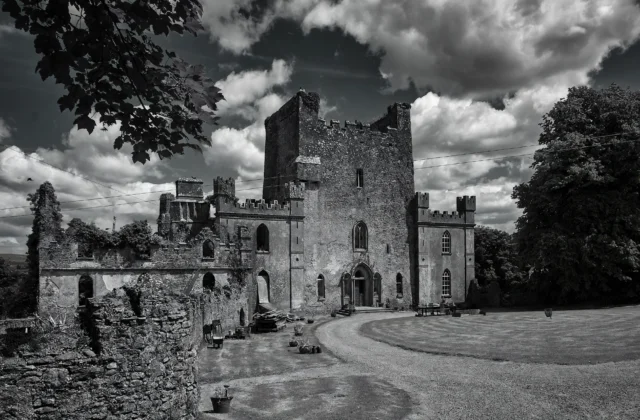
On the windswept tip of the Hook Peninsula in County Wexford, within sight of Hook Lighthouse, Loftus Hall stands alone against the Irish Sea. It is a large, grey country house that locals have long called the most haunted house in Ireland, a place said to have been visited by the devil himself and by the ghost of a young woman who died waiting for him to return.
Most people who know the name know the card game. Fewer know that the house began as a Norman fortification in 1350 during the Black Death, survived a 10-man defense against 90 soldiers, was stripped for Cromwell, rebuilt as a Victorian showpiece for a visit from Queen Victoria that never happened, and then spent a century as a convent, a hotel, and an abandoned shell used for satanic rituals before it became a ghost-tour attraction.
Houseland Castle to Redmond Hall, and a Family Who Would Not Leave
The story begins not with the Loftus family at all, but with Raymond FitzGerald, known as Le Gros, who landed at Baginbun in 1170 to secure the arrival of Richard de Clare. He built a castle at Houseland. His descendants replaced it around 1350, during the time of the Black Death, with what became known as Redmond Hall.
That hall became famous in 1642. During the Irish Confederate Wars, its owner Alexander Redmond, then 68 years old, barricaded himself inside with just nine other defenders – his sons, four tenants, two men-at-arms and an itinerant tailor who happened to be working there – armed only with long-barrelled fowling pieces. An Irish Army force of 90 men under Captains Weldon and Aston landed with two small cannons and demanded entry in the name of King Charles I. Redmond told them they could come in if they left their weapons outside. A lengthy firefight ensued, the cannon too small to breach the door, until a Confederate relief force arrived under cover of sea-mist and routed the attackers.
The family held on, but not for long.
The Cromwellian Confiscation and a Name Carved in Stone
After the Cromwellian conquest of Ireland, Alexander Redmond’s family were evicted, allowed to retain only a third of their estates. The Loftus family, English planters in the area since Sir Dudley Loftus was granted lands around 1590, were given extensive lands in the south of Wexford. Nicholas Loftus purchased the hall from adventurers and soldiers, but it was his son Henry who moved there in 1666 and made it the principal residence.
To establish the new name, he had an inscription cut into the entrance piers at Portersgate: “Henry Loftus of Loftus Hall Esq. 1680.” Even so, the old name lingered until the end of the century. The Redmonds disputed the claim in court without success and were compensated with lands in the north of the county. Some descendants would later join the Wild Geese; one, John Redmond, would lead the Irish Party until 1918.
The Loftus family rose. In 1800 Charles Loftus, Baron Loftus, was created Marquess of Ely.
A Marquess’s Folly Built for a Queen Who Never Came
The house you see today is not the 14th-century hall. Between 1872 and 1884, John Henry Wellington Graham Loftus, the 4th Marquess of Ely, under the guidance of his mother Lady Jane Hope Vere Loftus, Lady in Waiting to Queen Victoria, undertook an extensive rebuilding of the entire mansion.
He added the grand staircase, mosaic tiled floors, elaborate parquet, flushing toilets and blown-air heating – technical elements not seen in Irish houses at the time. Much of the inspiration was taken from Osborne House, the Queen’s summer residence on the Isle of Wight. The works were believed to have been undertaken to facilitate a visit from the Queen. The visit never happened, and the family never got to fully enjoy the house, with the 4th Marquess dying very young without issue and leaving the estate in a poor financial state.
A Convent, a Hotel, and a Decade of Abandonment
In 1917 Loftus Hall was bought by the Sisters of Providence and turned into a convent and a school for young girls interested in joining the order. In 1983 Kay and Michael Devereaux purchased it and opened it as the Loftus Hall Hotel, which operated until its closure in the late 1990s.
What followed was a long vacancy. The hall suffered vandalism and misuse for satanic rituals until it was bought by the Quigley family in 2011. Purchased by Shane and Aidan Quigley, it was opened to the public in 2012 with guided tours and a fully restored walled garden, and for a time hosted paranormal investigations, including a visit from Ghost Adventures. It was put on the market in 2020, sold in 2021, and as of late 2025 has been listed as sold, its future as a proposed hotel project uncertain.
The Card Game, the Cloven Hoof, and the Hole That Could Not Be Repaired
It is during the earlier Loftus occupation that the legend that defines the house is set, in 1775.
Charles Tottenham, who had taken the Loftus name to inherit lands and title after marrying the Honourable Anne Loftus, was living there with his second wife Jane Cliffe and his daughter from his first marriage, Anne. One evening during a violent storm, a ship arrived unexpectedly at the Hook Peninsula and a young stranger, described as dark and handsome, sought shelter and was welcomed into the mansion.
Over several days, Anne Tottenham became close to the visitor. One evening the family and the stranger were in the game room playing cards. In the game each player received three cards, apart from Anne who was only dealt two by the mystery man. At one point Anne dropped a card and bent down to retrieve it.
It is said that when she looked beneath the table she saw that the mysterious man had a cloven foot instead of a human foot. She stood and said, “You have a cloven foot!” The man then went up through the roof in a ball of flames, leaving behind a large hole in the ceiling.
The story diverges slightly in the telling, but the core remains: Anne never recovered from her ordeal. The family, ashamed, locked her away in her favourite room – the Tapestry Room – where she would be happy, yet out of everyone’s view. She refused food and drink, and sat with her knees under her chin, looking out the window across the sea toward Dunmore East, waiting for her mysterious stranger to return, until she died there in 1775. According to the story, her muscles had seized and the family could not straighten her body, burying her in the same sitting position.
Locals claimed the hole in the roof where the stranger, believed to be the devil, shot through could never be properly repaired.
Why Loftus Hall Is Considered Haunted
Loftus Hall’s reputation as Ireland’s most haunted house rests on two figures: the devil himself, and the ghost of Anne.
The most reported location is the Tapestry Room, where Anne is said to have died. Visitors on day tours have described an overwhelming sense of dread, cold spots, and the feeling of being watched. The Quigley-era tour guides reported apparitions of a young woman at the window, disembodied voices, and unexplained electrical malfunctions.
During its years as a haunted attraction, the hall invited paranormal teams to investigate. Guides recounted spikes in electromagnetic fields, EVPs captured in empty rooms, and reports of shadow figures on the grand staircase added by the 4th Marquess. Like many Irish sites, it has also been linked by amateur researchers to ley lines and vortex energy, though those claims have no archaeological basis and belong to modern folklore rather than documented history.
The most persistent piece of folklore is not an EVP but architecture: for generations, workers are said to have been unable to permanently patch the roof where the devil left.
Visiting Loftus Hall Today
Loftus Hall is located at Hook Head, near Templetown, County Wexford, Ireland, about 33km south of New Ross, on the Hook Head Peninsula.
For most of the last decade it operated as a tourist attraction with daytime house tours and limited adult-only, 21+ tours after nightfall. Admission during that period was around €10 for a standard tour. Since its closure in 2020 and sale in 2021, the house has been under renovation and not open to the public. In 2022 it was reported as under renovation and closed, and as of 2025 it remains listed as sold.
Anyone planning a trip should check the official Loftus Hall channels before traveling, as access, tour times, and admission prices have changed frequently with ownership. The Hook Peninsula itself remains publicly accessible, with Hook Lighthouse – the oldest intact operational lighthouse in the world – less than a mile away.
Would you spend a night in the Tapestry Room if it reopened, or is a daytime walk of the walled garden more your speed?
Sources consulted for the historical details in this post include the Wikipedia entry on Loftus Hall for its construction dates, ownership chain, and 1642 skirmish; Spooky Isles, “Chilling Truth Behind Ireland’s Loftus Hall Secrets,” for its Quigley-era history and period of vandalism; IfCurious.ie for its convent, hotel, and tour information; and Roscommon Herald / Tailte Éireann for the card game legend and Tapestry Room account.