The Case in Brief
The Tower House So Violent Its Own Family Turned It Into Fiction Leap Castle sits on a narrow pass through the Slieve Bloom Mountains…
The Tower House So Violent Its Own Family Turned It Into Fiction
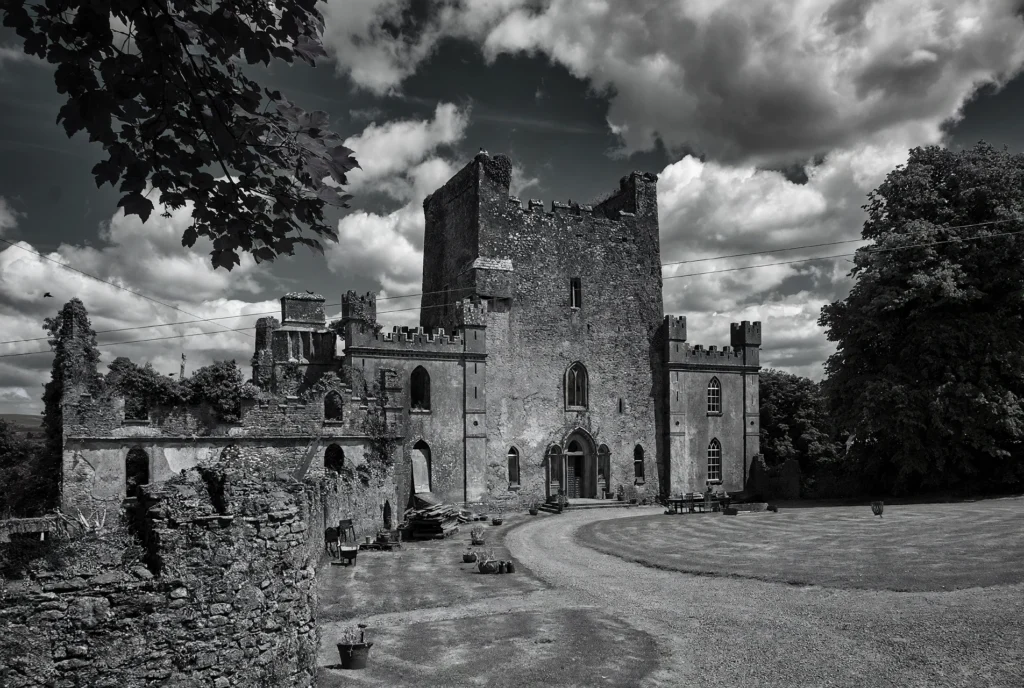
Leap Castle sits on a narrow pass through the Slieve Bloom Mountains in County Offaly, the kind of chokepoint a medieval chieftain needed to control movement between the provinces of Munster and Leinster. That strategic value is the plain, unglamorous reason the castle exists, and it is easy to forget once the conversation turns, as it almost always does, to the building’s reputation as Ireland’s most haunted castle. What makes Leap unusual among Ireland’s haunted houses is how much of that reputation can be traced to a single, identifiable source: not vague folklore accumulated over centuries, but the personal writings of one Victorian woman who lived there, whose own husband once accused her, to her face, of faking it.
A Tower House Guarding the Pass
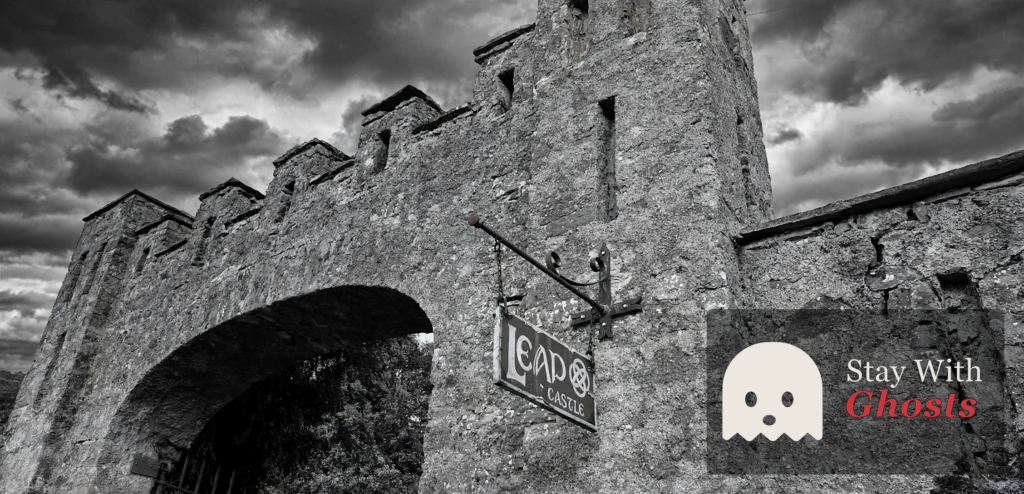
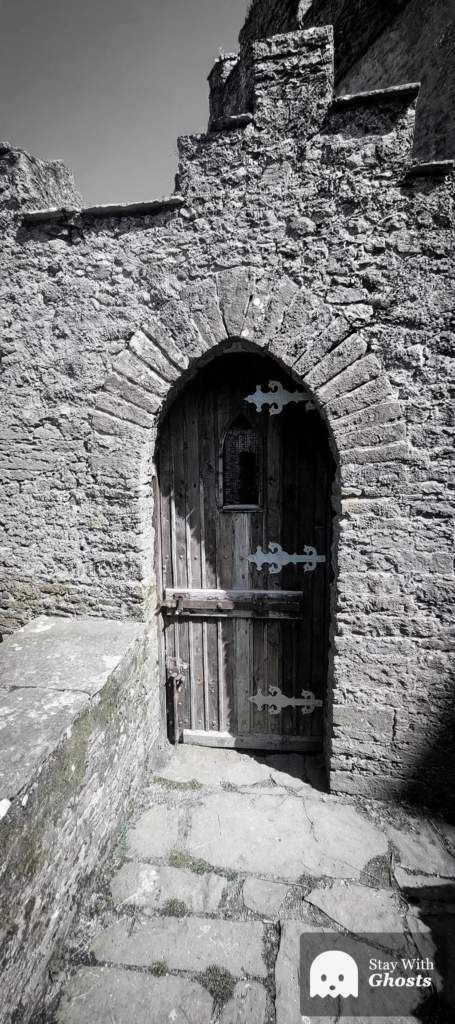
The castle takes its English name from a Gaelic original, Léim Uí Bhanáin, the Leap of the O’Bannons, the family who most likely built the first tower house on the site around 1250 as a secondary stronghold under their overlords, the O’Carroll clan of Ely O’Carroll. What stands today is a fairly typical, if imposing, Irish tower house: a rectangular limestone block roughly 13 by 10 metres with walls over two metres thick, a crenellated parapet and machicolations for dropping objects on attackers below, and an interior spiral staircase connecting three storeys around a barrel-vaulted ground floor with a large open fireplace. It was built for defense first and comfort a distant second, exactly what a family controlling a contested mountain pass needed. The O’Carrolls eventually absorbed the O’Bannon lands outright and held Leap as their own by the early sixteenth century, by which point the castle had already survived one serious attempt to take it by force.
Kildare’s Sieges and a Family’s Civil War
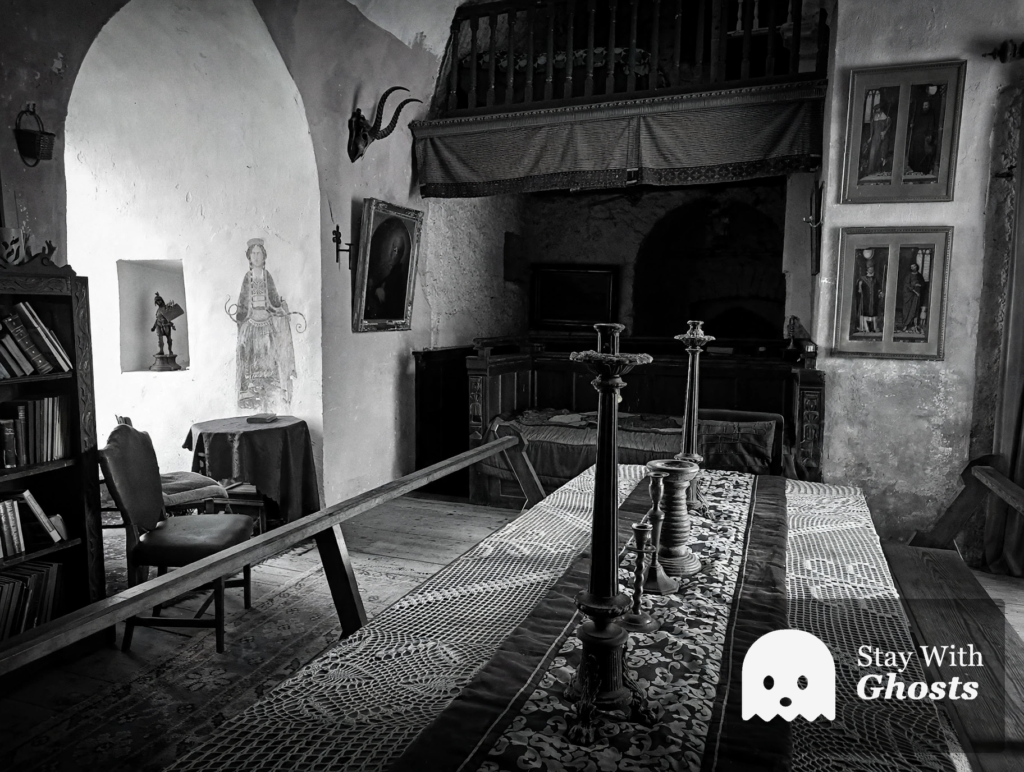
Gerald FitzGerald, the powerful Earl of Kildare, attacked Leap Castle in 1513 and again in 1516, partially demolishing sections of it in the process, but the O’Carrolls held on and had fully regained and repaired the castle by 1557. The more consequential violence, though, came from within the family rather than from outside it. When the O’Carroll chieftain Mulrooney O’Carroll died in 1532, the succession dissolved into open conflict among his sons, and it was during this family civil war that Leap Castle acquired the story that still defines it. According to the surviving tradition, one O’Carroll brother, reputedly ordained as a priest, was celebrating Mass in the castle’s small private chapel when a rival brother, remembered afterward as Tadhg Caoch, One-Eyed Tadhg, burst in and stabbed him to death across the altar rail in front of the assembled family. The room has been known ever since as the Bloody Chapel, and the murder is consistently cited as the seed of everything that followed.
Historians who have examined the room itself, however, have raised a genuinely interesting complication: it may never have functioned as a chapel at all. Architectural analysis of Leap’s interior suggests the room was originally an ordinary domestic space of the kind tower houses generally used as halls, and that the chapel label was most likely applied later, retrofitted onto the room specifically to give the fratricide legend a suitably sacrilegious stage. None of that makes the underlying killing any less real; dynastic murder was common enough in O’Carroll-era Ireland, but it is a useful reminder that even Leap’s oldest and most solemnly repeated ghost story has already passed through at least one layer of dramatic embellishment before reaching the present day.
Irish folklorists have separately grouped the Bloody Chapel legend with a small cluster of native blood-drinking-spirit traditions, in which a murderer’s soul is barred from the afterlife and forced to sustain itself on the blood of anyone who comes near the castle. Some scholars researching the folklore behind Bram Stoker’s Dracula have pointed to exactly this category of native Irish legend, blood-drinking undead spirits tied to a specific place and a specific ancestral crime, as part of the wider well of material Stoker, whose own mother grew up steeped in Irish folk tradition, likely drew on decades before he ever wrote a word about Transylvania. Leap’s version of that tradition predates Stoker’s novel by more than three centuries, which makes the Bloody Chapel less a footnote to Dracula than one of the older, homegrown examples of the same folkloric instinct.
The Darbys and the Woman Who Wrote the Ghosts Down
Ownership passed out of Irish hands in 1642, when the castle came to the English Darby family through marriage into the O’Carroll line, and it stayed with the Darbys for the better part of three centuries. The single most important figure in Leap’s modern reputation, though, is not any medieval chieftain but Mildred Darby, the English-born wife of Jonathan Darby, who moved into the castle after their marriage in 1889 and spent years afterward uneasy in her role as an outsider presiding over a deeply resented colonial household. Mildred began writing professionally not long after arriving, and in 1908 she published a Gothic short story, thinly disguising Leap as Kilman Castle, which she insisted in its preface was based on events that had actually happened to her. The story centers on a menacing, shapeless presence she called the Elemental, sometimes simply the thing or It, and it reads as a guided tour of the castle’s supposedly haunted rooms, with a visiting character moved from bedroom to bedroom over several nights specifically so the narrative could catalogue each one’s resident ghost in turn. Even the castle’s fictional stand-in family, renamed the O’Connells in Mildred’s telling, was a deliberate literary invention, an Anglo-Irish family recast as ancient Gaelic chieftains in a novel written squarely in the romantic, Celtic Revival tradition of the era, which suggests the entire haunted-house framing may owe as much to contemporary literary fashion as to anything that happened inside the actual walls.
What makes Mildred’s account so unusual, compared with most haunted-house origin stories, is that her own private correspondence survives alongside the fiction, and it complicates the story rather than confirming it. In one letter describing an alleged encounter with the Elemental, she recorded that her husband Jonathan stormed into her room at midnight, furious and frightened, accusing her outright of “again dressing up things to try and frighten me.” In other words, the person who lived with Mildred Darby every day suspected that at least some of Leap’s hauntings were his own wife’s invention, staged for effect, rather than anything supernatural. Later reports from the household do show a marked escalation in ghostly detail compared with earlier generations’ accounts, consistent with a story that grew more elaborate the longer Mildred told it. None of this proves anything ever happened at Leap Castle; it simply means that the version of the haunting most visitors hear today was substantially shaped, curated, and in her husband’s own words, possibly staged, by one specific Victorian writer with a Gothic novel to promote.
Burned in the Irish Civil War
The Darby family’s long tenure ended abruptly in 1922, during the Irish Civil War, when raiders entered the largely empty castle, distributed petrol through its rooms, and set it ablaze, gutting the building down to its stone shell. The Darbys later filed a war-damage claim for £22,684, a substantial sum for the period, though they ultimately settled for considerably less. The fire’s silver lining, if it can be called that, is a strange one: because so little of the castle’s Victorian interior survived intact, Mildred Darby’s own fictionalized account of its layout and its haunted rooms became, by default, one of the few detailed descriptions of what the building actually looked like before it burned, a Gothic ghost story doubling as an accidental architectural record.
The Oubliette and Its Bones
Leap Castle sat as a roofless ruin for decades after the fire, and it was during earlier restoration work, in 1909, before the burning, that workers made the discovery now central to the castle’s darkest legend. Clearing out a small chamber off the Bloody Chapel, they found a hidden oubliette, a windowless pit roughly eight feet square and twenty feet deep, its floor fitted with wooden spikes positioned to impale anyone dropped through the trapdoor above. The pit contained the skeletal remains of what restorers estimated at several hundred people, reportedly requiring three full cartloads to clear, along with scattered personal items, pocket watches, buttons, small pieces of jewelry, suggesting victims had been disposed of there across a considerable span of time rather than in any single incident. Workers at the time also described a smell of decay that was said to linger around the site for years afterward, a detail later visitors and ghost hunters have repeatedly cited, whether or not there is any physical mechanism left, a century later, that could actually produce it.
The scale of the discovery is worth sitting with on its own terms. Several hundred sets of remains, spanning what the mixed personal effects suggest was a period of many decades rather than one violent episode, point toward an oubliette used routinely, over generations, as a way of disposing of prisoners, enemies, or anyone else the castle’s occupants wanted permanently gone. Whatever else is folklore and embellishment at Leap, the oubliette is not: it is a physically documented feature of the building, and its contents are the closest thing the castle offers to hard evidence that its violent reputation was earned rather than invented.
Why Visitors Call It Haunted
The Elemental remains Leap’s signature haunting, now generally described in ghost-tourism accounts as a sinister, semi-formed presence accompanied by a strong smell of sulphur or decay, provoked into appearing rather than freely wandering the halls, and popularly, though quite speculatively, linked by some tellers to the Earl of Kildare’s sixteenth-century sieges or even older druidic activity on the site, connections with essentially no documentary support beyond their usefulness as backstory. A Red Lady, dressed in a long red gown and carrying a dagger, is said to haunt the grounds, her story usually tied to an assault or murder involving the O’Carroll family, though the specific details shift considerably from one telling to the next. Two child ghosts, generally named Emily and Charlotte, are associated with the castle’s upper floors, one said to have fallen from the battlements and the other to walk with a limp, while the Priest’s House nearby is linked to the murdered brother from the Bloody Chapel story and an accompanying monastic figure. Current owners Sean Ryan and his wife Anne, who have lived at Leap for decades, have generally spoken about the castle’s reputation with a certain matter-of-fact calm, acknowledging the stories without personally reporting the kind of dramatic encounters the castle’s legend might lead a visitor to expect.
Restoring a Ruin
The castle stood as a shell for half a century after the 1922 fire before the Australian historian Peter Bartlett purchased the ruin in 1974 and began the slow work of making it habitable again, a project that occupied him until he died in 1989. Musician Sean Ryan and his wife Anne bought Leap Castle in 1991 and have continued that restoration in the decades since, gradually returning rooms to use while keeping the building’s medieval character intact, alongside Ryan’s own career performing traditional Irish music, some of it recorded inside the castle itself.
Visiting Leap Castle Today
Leap Castle remains a private home rather than a standard tourist attraction with posted hours or an admissions desk, and visits are arranged directly with the owners rather than booked through any conventional ticketing system. Paranormal investigation groups and small tour parties do visit by prior arrangement, and the castle has appeared repeatedly on international ghost-hunting television, but anyone planning a trip should confirm current access directly rather than assume the castle keeps regular visiting hours, since arrangements have changed considerably over the decades since Bartlett first began clearing the rubble. The wider Offaly countryside around Leap, at the edge of the Slieve Bloom Mountains near Roscrea, rewards the trip regardless, with walking trails through the range’s forested slopes offering a quieter, decidedly less haunted way to spend the rest of the day.
Does the fact that Leap’s most famous ghost story can be traced back to one specific writer, and her husband’s own suspicion that she staged it, change how unsettling you find the Elemental, or does knowing the source make the castle’s older, murkier history, the Bloody Chapel and the oubliette, feel like the more genuinely disturbing part of the story? Let us know in the comments below.
Sources consulted for the historical details in this post include Andrew Tierney, “The Gothic and the Gaelic: Exploring the Place of Castles in Ireland’s Celtic Revival,” International Journal of Historical Archaeology, Vol. 8, No. 3 (September 2004), pp. 185–198; Bob Curran, “Was Dracula an Irishman?,” History Ireland, Vol. 8, No. 2 (Summer, 2000), pp. 12–15 (accessed via JSTOR); the Wikipedia entry on Leap Castle; Ancient History Sites’ architectural survey of Leap Castle; Ireland Before You Die’s history and ghost guide; and Haunted Silence’s account of the 1909 oubliette discovery.