The Case in Brief
England’s Most Haunted House Rests on a Surprisingly Thin Historical Foundation Few buildings in England carry a reputation as heavy as the Ancient Ram…
England’s Most Haunted House Rests on a Surprisingly Thin Historical Foundation
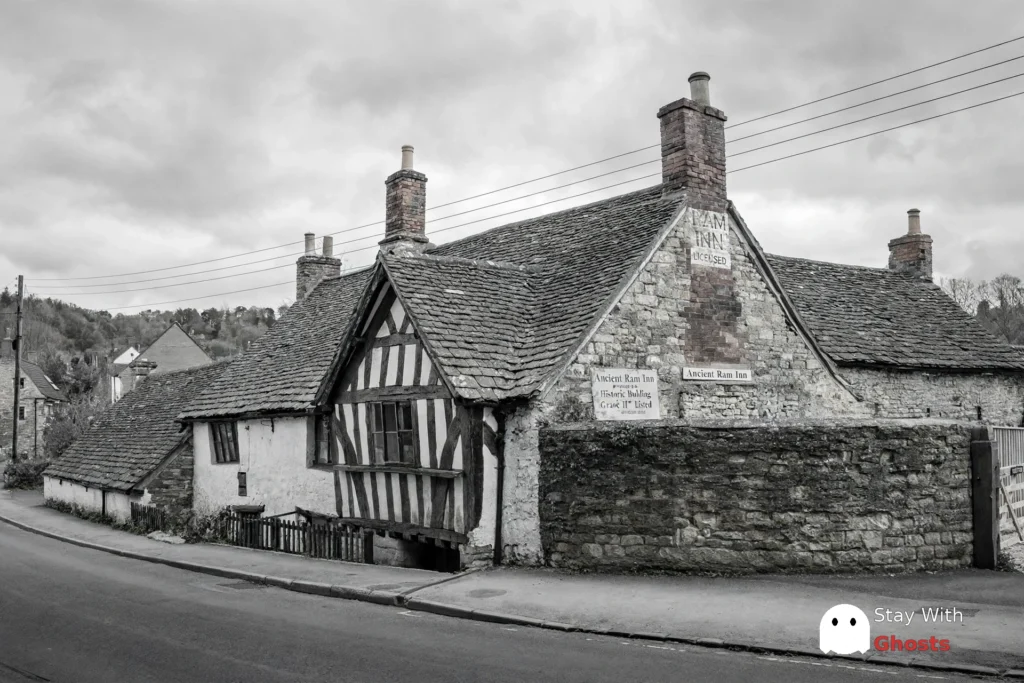
Few buildings in England carry a reputation as heavy as the Ancient Ram Inn’s. Tucked into a steep street in Wotton-under-Edge, Gloucestershire, the timber-framed hall house has been marketed for decades as the most haunted building in the country, home to some twenty spirits, a resident succubus, and a set of child skeletons its late owner insisted he found beneath the floorboards.
What makes the Ram Inn an unusual case study, though, is not the ghost stories themselves, familiar territory for any old English building, but how far its popular history has drifted from what can actually be documented. Strip away the legend and the building that remains is still strange and still old, just not nearly as old, or as ecclesiastical, as the story claims.
A Timber Hall House With a Contested Birth Date
The Ram Inn’s own promotional material has long dated the building to 1145, claiming it was built to house the stonemasons and laborers constructing the nearby St Mary’s Church and that it later served as the parish vicar’s residence starting in 1154. It is a tidy origin story, and almost none of it holds up against the physical evidence. The building is Grade II* listed, and Historic England’s own listing describes its earliest fabric as late medieval, remodelled in the mid-to-late sixteenth century. At the same time, dendrochronology, tree-ring dating of the surviving timbers, has placed its actual construction in the winter of 1495 to 1496, more than three centuries after the date the legend claims.
St Mary’s Church itself complicates the masons’ lodge story further: its earliest fabric dates only to the thirteenth century, meaning the church the Ram Inn supposedly housed workers for did not yet exist when the inn was allegedly built. Surviving property deeds from 1532 point toward a more mundane origin, ties to the local wool and textile trade rather than the church, and documentary evidence suggests the building most likely functioned as a parish church house, a venue for community gatherings and entertainments, by the 1530s. It appears to have become a public house in its own right around 1820, the identity it held for the next century and a half.
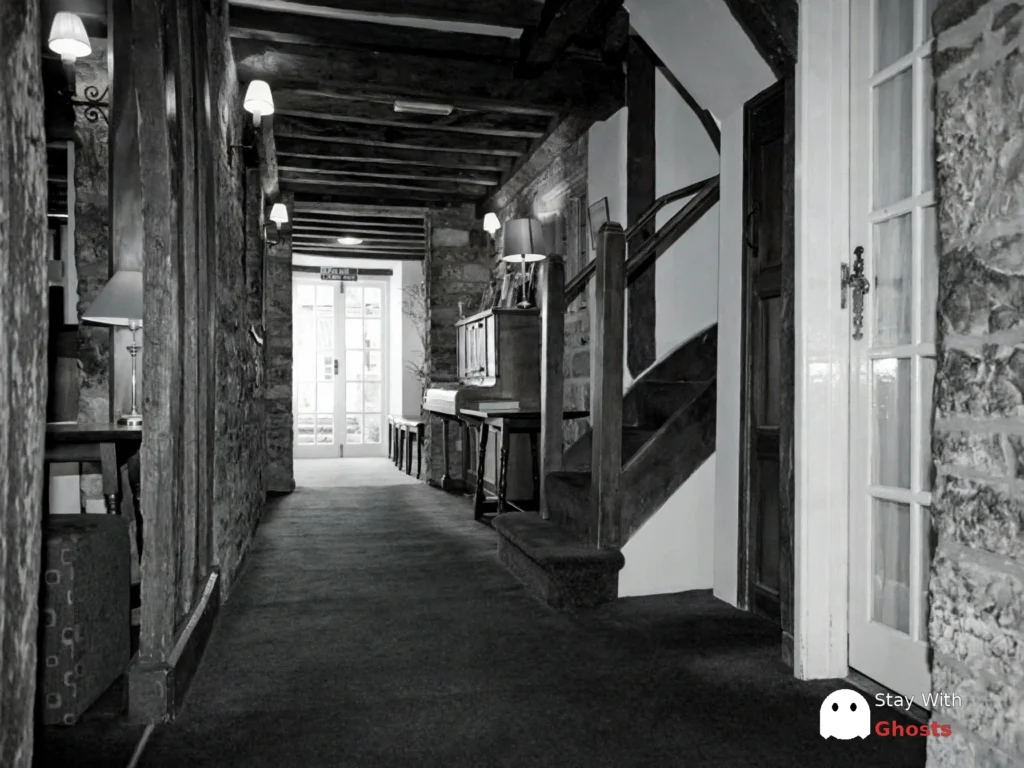
The surviving fabric backs up that more workaday reading. Historic England’s listing describes a building of rendered limestone rubble and timber framing, laid out in the complex, multi-phase plan typical of a three-unit medieval inn rather than a single-purpose ecclesiastical residence. It retains a late medieval collar-truss roof with a threaded ridge purlin and wind bracing, a jettied first-floor gable of close studding and arch bracing, and a hall lit by sixteenth- and seventeenth-century wood-mullioned windows with ovolo-moulded frames, entered through a chamfered timber doorway fitted with a studded plank door.
Investigators have also noted the striking absence of smoke blackening on the hall’s timbers, evidence against the building ever having functioned as an open medieval hall heated by a central hearth, and evidence for the theory that it began life as an upper-floor hall, quite possibly the parish church house the 1530s records point toward, rather than anything built for monks or masons five centuries earlier.
A Market Town Built on Wool
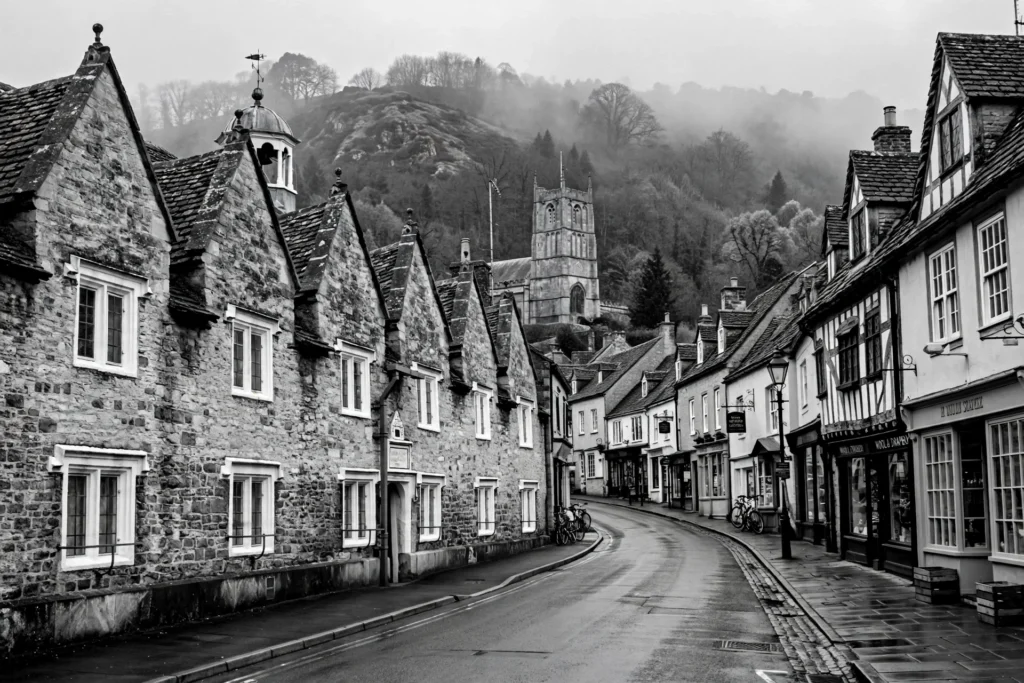
The inn’s real origins make considerably more sense once set against the town around it. Wotton-under-Edge received its borough charter in 1252, and the medieval street layout laid out around that charter still shapes the town center today. Nestled beneath the Cotswold escarpment roughly halfway between Bristol and Gloucester, Wotton built its long medieval and early modern prosperity on the wool trade, reinforced by close ties to the Berkeley family at nearby Berkeley Castle, and the town still carries the physical evidence of that wealth in its parish church, three sets of historic almshouses, and its well-preserved core of merchants’ houses.
Set against that backdrop, a substantial timber-framed building linked by its own surviving deeds to wool merchants and the local textile trade looks far less like a mystery requiring a supernatural explanation and far more like exactly what a prosperous wool town of the period would be expected to produce.
From Public House to Private Obsession
The Ram closed as a working pub around 1965. Three years later, in 1968, a builder named John Humphries bought the derelict property for roughly two thousand pounds. The sale came with a restrictive covenant, common enough in England at the time, barring him from reopening it as a licensed pub in competition with the brewery’s other local interests, and the cellar was reportedly filled in to help enforce it. Humphries initially planned to run the building as a guest house, a venture he eventually abandoned, and instead simply lived there, alone for most of that time, for nearly fifty years.
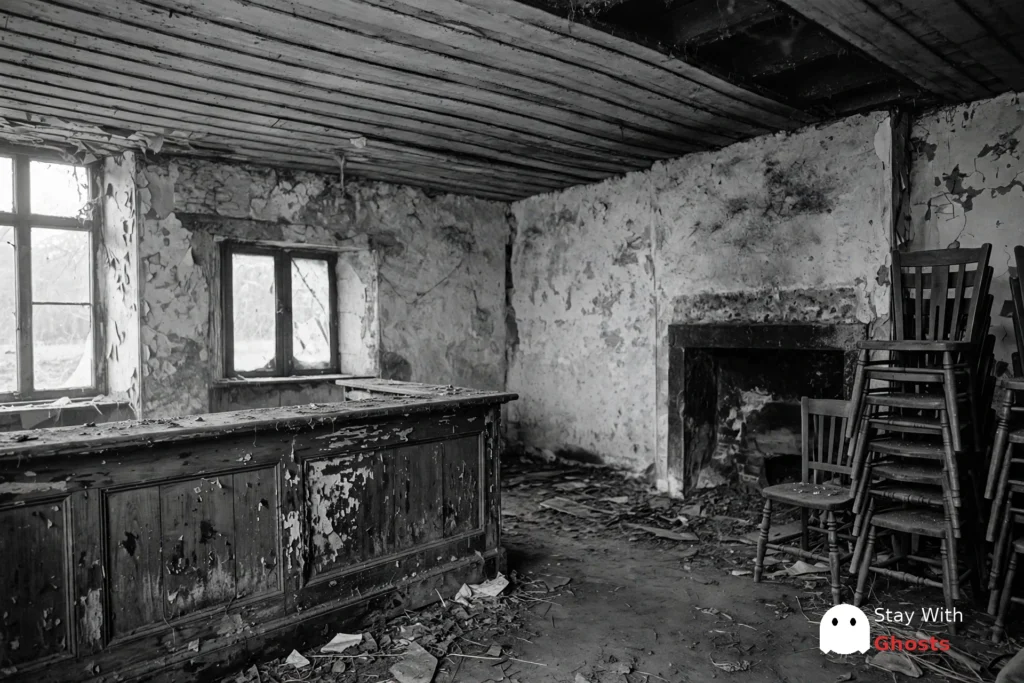
By his own account, the haunting announced itself almost immediately: on his first night in the building, he claimed to have been seized and dragged bodily across the room by an unseen force. He would go on to describe decades of similar encounters, culminating in a claim that in 1997 he uncovered human remains, a woman and a child, beneath the floorboards, which he took as evidence of ritual child sacrifice and devil worship on the site in centuries past. No archaeological excavation, inquest, or independent record of that discovery has ever been published; the claim exists solely in Humphries’s own retelling and the tourism material built around it. He remained in the building until roughly eighteen months before his death in December 2017, at the age of eighty-nine.
The Rooms and Their Reputations
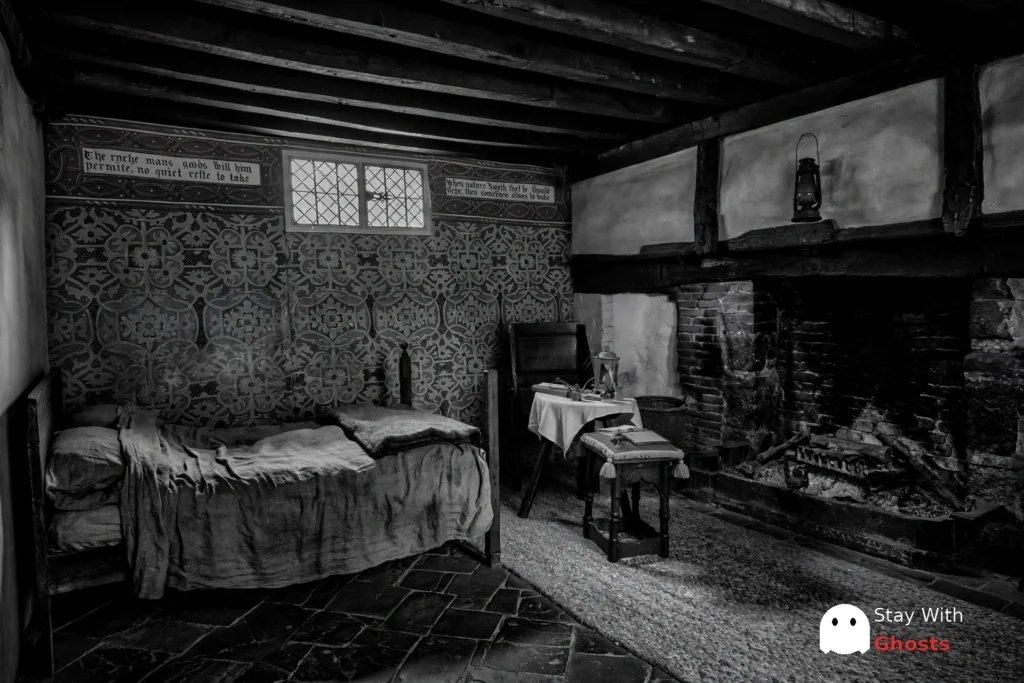
Much of the Ram Inn’s modern folklore is organized room by room, each with its own cast of alleged entities. The Bishop’s Room, on the first floor, is generally described as the most active, said to host the spirits of several bishops alongside darker monastic figures, a Cavalier-era apparition, and a hanging woman; horseshoes and carved wooden circles found sealed inside its chimney have been interpreted by paranormal investigators as evidence of protective or devil-worship rituals rather than ordinary period ironwork.
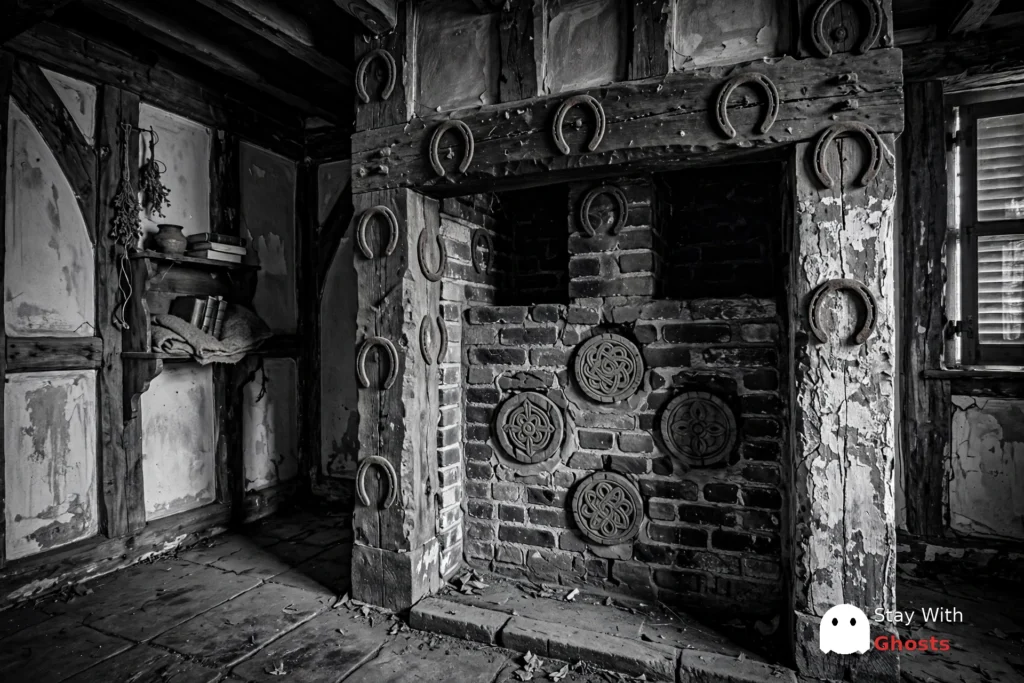
It was also the room Humphries slept in, and the one where he and numerous overnight visitors have reported being pinned or smothered in their sleep by a succubus, a folkloric demon that assaults the sleeping. The Witch’s Room takes its name from a local legend that a woman accused of witchcraft sheltered there in the sixteenth century before being burned at the stake; visitors on the street outside have reported seeing a woman’s face in the window glass.
In the attic, the Weaver’s Room is attributed to a young woman named Elizabeth, said to have been murdered in the same period, and is associated with more conventional poltergeist activity, objects moved or thrown, including tarot cards left out during ghost-hunting events. A black cat said to speak, and various half-glimpsed shadow figures, round out an unusually crowded roster of alleged occupants for a building of modest size.
Paranormal investigators who have run overnight vigils there tend to describe the same handful of recurring impressions rather than dramatic full apparitions: sudden temperature drops, a sense of being watched in the Bishop’s Room specifically, and disembodied footsteps on the stairs connecting the ground floor to the attic. None of it has ever been independently verified under controlled conditions, and the building’s own decades-long reputation as a ghost-hunting venue means that any given account arrives already shaped by everything a visitor has read or watched beforehand.
Ley Lines, a Pagan Burial Ground, and the Limits of the Evidence
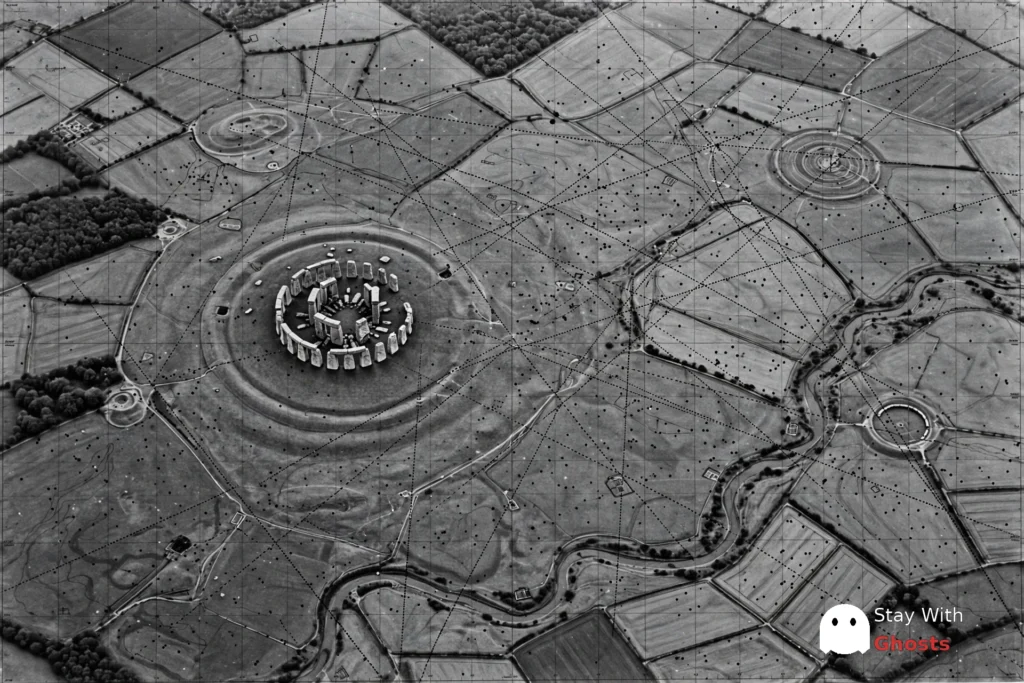
The claim that gives the Ram Inn’s hauntings their supposed deep-time explanation is that the building sits at the intersection of two ley lines, an alignment paranormal tour guides connect all the way to Stonehenge, and that it was built directly atop an ancient pagan burial ground whose disturbance released, in the popular phrasing, dark energy that had been dormant for millennia. Neither claim survives contact with the actual record.
Historic England’s Gloucestershire archaeology databases contain no entry for a pagan burial ground anywhere in the vicinity of Wotton-under-Edge; a discovery of that scale would be catalogued and cross-referenced as a matter of course, and its total absence from those records is itself informative. The ley line concept fares no better under scrutiny. When statisticians began testing Alfred Watkins’s 1920s ley-line hypothesis rigorously in the late twentieth century, Simon Broadbent’s 1980 study in the Journal of the Royal Statistical Society simulated random distributions of ancient monuments across the landscape and found that the kind of apparent alignments ley hunters were finding occurred about as often by pure chance as they did in the real, surveyed terrain, undercutting the idea that such alignments were evidence of deliberate ancient design at all.
Scholars of contemporary paganism have separately traced how sites like Stonehenge became magnets for exactly this kind of alternative archaeology, absorbing ley lines, earth energies, and invented ritual landscapes into their modern identity regardless of what the excavated evidence supports. None of this means the Ram Inn’s stone and timber aren’t genuinely unsettling to stand inside after dark; it means the ancient pedigree attached to the feeling is a twentieth-century invention layered onto a fifteenth-century building, not a discovery. It is, in that sense, a fairly ordinary example of a broader pattern historians of myth-making have documented elsewhere in England, in which a real medieval institution, in the case of the Knights Templar, gets stripped of its actual, well-documented history and rebuilt in the popular imagination as something considerably stranger.
A Star Turn on Ghost-Hunting Television
Whatever its historical basis, the Ram Inn’s reputation was made for television, and television returned the favor. The American series Ghost Adventures filmed an episode inside the building in 2009, sending its crew through an all-night lockdown investigation that remains one of the show’s most referenced international episodes, and the long-running British series Most Haunted filmed there as well, part of a broader wave of paranormal programming in the 2000s that turned a handful of British buildings, this one included, into recognizable fixtures of the genre. That television exposure, far more than any documented medieval history, is almost certainly what cemented the building’s marketing as the most haunted house in England.
Visiting the Ancient Ram Inn Today
The Ram Inn remains in the Humphries family, now owned and run by John Humphries’s daughter, Caroline, who grew up in the building as a child before her parents separated and has spoken publicly about wanting to see it used for weddings, community events, and eventually a restaurant, alongside its continuing life as a paranormal destination. The building currently operates through organized open days and overnight ghost hunts, in which visitors join group vigils and run their own equipment through its most famously active rooms; details and bookings are handled through the inn’s own website rather than any standard hotel platform, since the building does not otherwise operate as a place to simply book a room for the night.
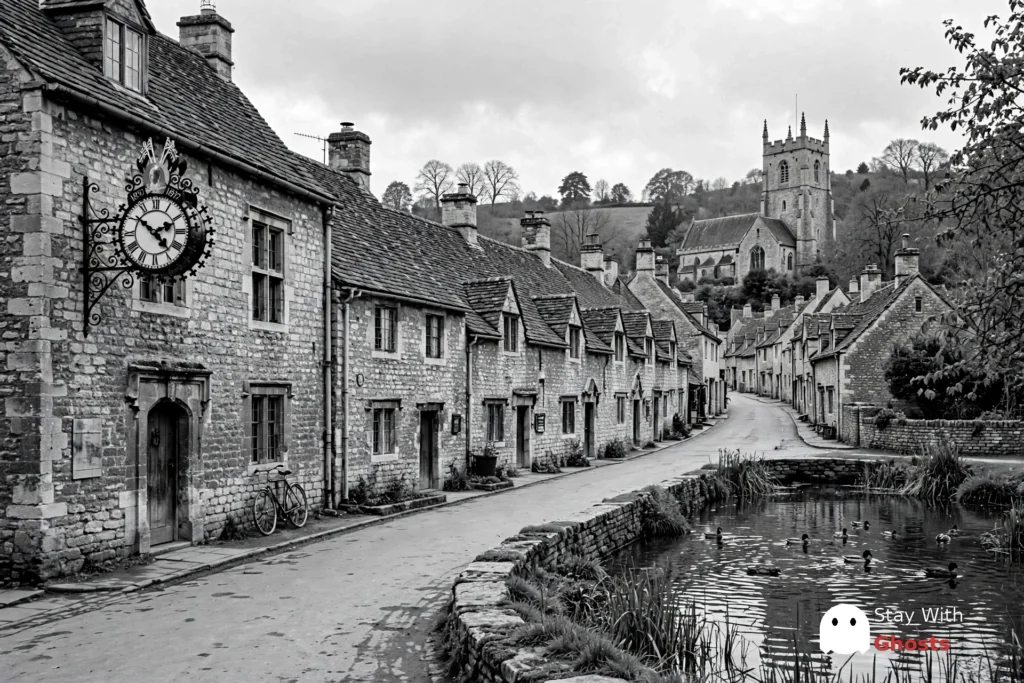
Visitors who make the trip can easily fold the inn into a wider look at Wotton-under-Edge itself: the town’s medieval core sits only a short walk away, anchored by St Mary’s Church, the same building the Ram Inn’s founding legend claims to have been built to serve, along with the seventeenth-century Tolsey Clock and the town’s historic almshouses, all reachable on foot from Potters Pond. Visitors expecting a slick, professionally staged haunted attraction should adjust their expectations: one recent visitor described the interior’s deliberately unsettling clutter of dolls, taxidermy, and religious ephemera by noting that “the stage has been immaculately prepared,” an observation that applies equally well to the building’s centuries and to its legend.
Does the gap between the Ram Inn’s marketed medieval origin story and its documented fifteenth-century construction change how you read its ghost stories, or does a genuinely old, genuinely strange building not need an inflated birth certificate to feel haunted? Let us know in the comments below.
Sources consulted for the historical details in this post include Simon Broadbent, “Simulating the Ley Hunter,” Journal of the Royal Statistical Society. Series A (General), Vol. 143, No. 2 (1980), pp. 109–140 (accessed via JSTOR); Carole M. Cusack, “Charmed Circle: Stonehenge, Contemporary Paganism, and Alternative Archaeology,” Numen, Vol. 59, No. 2/3 (2012), pp. 138–155 (accessed via JSTOR); a review of Peter Partner, “The Murdered Magicians: The Templars and Their Myth,” in Medium Ævum, Vol. 52, No. 1 (1983), pp. 187–188 (accessed via JSTOR); the Historic England listing and Triskele Heritage’s dendrochronology-based analysis of the Ancient Ram Inn; the Wikipedia entry on the Ancient Ram Inn; Higgypop Paranormal’s history of the building’s ownership; Spooky Isles’s guide to its named rooms and entities; TravelAwaits’s visitor guide; and Ex Utopia’s first-hand account of an overnight visit.