The Case in Brief
The Fairy-Tale Castle Still Giving Up Its Secrets Johnstown Castle looks straight out of a fairytale, with its turrets and battleships castles reflecting in a still lake. A walled Victorian garden, plus peacocks that frequent the grounds,…
The Fairy-Tale Castle Still Giving Up Its Secrets

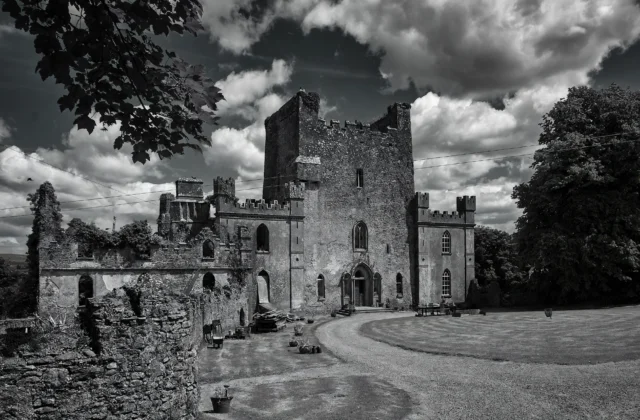
Johnstown Castle looks straight out of a fairytale, with its turrets and battleships castles reflecting in a still lake. A walled Victorian garden, plus peacocks that frequent the grounds, add to this image. The castle is one of Ireland’s most photographed buildings, popular for weddings and school excursions, but beneath its picturesque exterior lies eight centuries of devastation, executions, and a family history that one of its caretakers has described as tragic. Recent renovations have uncovered chambers within the castle that had been unknown to exist until 2023.
A Norman Tower House Renamed for a Man Called John
The first structure built on this site was a Norman tower house by the Esmonde family who arrived from Lincolnshire in southeast Ireland with the Norman invaders in 1169.
According to The Past , the journal of the Uí Cinsealaigh Historical Society, and family lore passed down through generations, it was John Esmonde who built the castle that the town is named after, several decades after his arrival. Johnstown Castle’s name comes from him, as he built it as his home. The family ruled over the region for over four centuries, in what the nineteenth-century local directory called “a warlike race”.
This long rule was brought to an end by Oliver Cromwell. On his march to the infamous Sack of Wexford, his Roundhead soldiers took up residence in the estate, as their own preparations for battle. Following years of sectarian violence, the Catholic Esmonde familywas expelled from their home in Johnstown. Their castle was “dismantled and left in a ruined state,” according to the Wexford County Guide and Directory of 1885. It was then gifted to a Cromwellian soldier and sold in 1692 to the Grogan family who remained there until the end of the century.

A Hanging on the Bridge He Paid For
The Grogans’ most dramatic chapter unfolded in 1798, when Cornelius (son of John) inherited Johnstown and its great estates, joined the United Irishmen’s rebellion that year, and was made commissary-general for Lord Edward Fitzgerald’s insurgent army in Wexford. Following the rebellion’s suppression, he was arrested, tried by court-martial on testimony that even his contemporaries acknowledged was not entirely reliable, and sentenced to death, for refusing to renounce his part-time involvement in the uprising.
On 28 June 1798, Cornelius Grogan was hanged and beheaded on Wexford Bridge (a public work in which, a few years previously, he’d donated £1000 towards its construction). His Johnstown estates were confiscated by the Crown in satisfaction of his fines, but not for long: in 1810 his share of the family estate was restored to his brother John Knox Grogan, and it was John’s son Hamilton Knox Grogan-Morgan who was responsible for transforming Johnstown into the castle we see today.
Aided by architect Daniel Robertson, he spent three decades converting the old tower house into a full-scale Gothic Revival castle, furnishing the grounds of the medieval Esmondes’ keep within a distinctly larger Victorian structure that wasn’t completed until 1872. By the 1850s, Hamilton Knox Grogan-Morgan was the largest single landowner in County Wexford.
The Last Lady of Johnstown
Johnstown castle was home to the Grogan’s descendants, who sold-out the manor to the FitzGeralds, after a century and a half of ownership. During the First World War, Johnstown was under Royal Naval Air Service’s jurisdiction, hosting the patrols searching for German U-boats. Still, the castle’s walls and its precious collectionsof antiques and paintings managed to survive the revolutionary period of 1920-23, when most of Ireland’s “big houses” were burnt or evacuated. It remained a private residence, fully furnished with a staff of servants, including a butler, footman, coachman, chauffeur, and gamekeeper, well into the 1940s, when Lady Adelaide FitzGerald, the 82-year-old owner, passed away in November 1942.
Her great-granddaughter’s family, who had been living in the castle, was faced with the need to find new owners for the estate. The Irish Government had desired to buy the Johnstown Castle to convert it into an agricultural college, and a private treaty might have been concluded to purchase some of its furnishings. Still, Lady Adelaide’s sons decided to auction the property.
Thus, on May 29 th , 1944, the auctioneers Jackson Stops & McCabe sold all 1,187 lots of goods from Johnstown’s Castle in a public auction that lasted a week. The goods included wardrobes, dumbwaiters, a child’s cot, a film projector, a Napoleonic collectionof weapons, 180 books listed on the catalogues, dozens of bronze and marble busts, and 45 family portraits.
The portraits included in the lots were all unnamed, except for the indication of the color of the dresses. Four of the lots weremarked as “Portrait of lady in blue gown,” while three lots weremarked as “Portrait of lady in brown gown.” Two lots were marked as “Portrait of lady in crimson gown.” All the rest were marked as “Portrait of lady,” with no indication of the color. No one knows who the owners of Johnstown Castle were, as their names were not indicated on their portraits, which were sold to different buyers in the same week of May 1944.
While the castle itself was transferred to the Irish State in 1945, as a provision in Lady Adelaide’s will to avoid further “death duties,” and turned into a soil research centre for the Department of Agriculture, the 800-year-old castle remained a home to various people. It was the home for the staff of the Agricultural Institute, the forerunner of Teagasc, before it was closed in 2003.

Why Johnstown Castle Still Unsettles People
The Haha Rath
Long before haunted rooms and household tragedies became a local obsession, residents of Johnstown were already being careful around the castle entrance. The 1885 edition of the Wexford County Guide and Directory contains an entry from a local legend that predates the county’s arrival on the scene. The legend is attached to a mound, or rath, which stands between the gatehouse and the parish church. When workmen building the road could not agree on a name for the mound, they left it up to the first passer-by, who happened to be a local girl who only giggled at their request.
The mound, since then known as the “Haha Rath”, supposedly has many who pass by it after dark anything but a laughing matter, according to the directory. This is a small, specific piece of folklore, attached to a specific landmark and a local legend predating Johnstown’s turrets.
Rooms No One Knew Were There
Whatever else might be said or written of Johnstown Castle, this much is indisputable and recent. During the course of restoration work to be conducted in 2022 at the castle, conservators discovered a hidden room within one of the lakeside towers, inaccessible by boat and never before described in any living memory.
Then in August 2023, a carpenter hired to assist in the replacement of one of the many windows in one of the castle’s turrets accidentally broke through to a second sealed room: a circular chamber roughly ten feet in diameter, walled off sometime in the nineteenth century for reasons no one seems to know.
Irish Heritage Trust CEO Anne O’Donoghue deemed it “highly unusual to find additional hidden treasures in heritage properties,” but Johnstown’s own manager at the time, Brenda Comerford, offered the most quietly unsettling commentary of all: “There is quite a tragic family history associated with Johnstown Castle, so this room could have been sealed off due to a tragedy, which would have happened in times past, who knows?” As of this writing, no one knows. The castle’s staff have already spoken plainly that there might be other undiscovered spaces behind the castle’s walls.
A History That Doesn’t Need Embellishing
Johnstown Castle doesn’t have a long-documented roster of named ghosts and repeated sightings the way some Irish castles do, and it’s worth saying so plainly rather than inventing one. What it has instead is a genuinely unsettled history: a family line that ended in a public beheading, a household emptied in a single chaotic week with its portraits, of women no one can now name, scattered to the wind, and a building that is still, provably, giving up rooms it kept secret for well over a century.
For a lot of visitors, that combination of real tragedy, real mystery, and walls that are still surprising the people who study them and does the job a ghost story usually does.
Visiting Johnstown Castle Today
Johnstown Castle Estate, Museum & Gardens is located southwest of Wexford town on the road between Murntown and Rathaspeck and under the care of the Irish Heritage Trust, an independent charity. The 150-acre estate encompasses the castle, the Victorian walled garden and lakeside walks designed by Daniel Robertson and the Irish Agricultural Museum, located in the oldstable yard.
The Gardens and the Irish Agricultural Museum are open for self-guided visits without booking. Guided tours of the castle, including the 86-metre servants’ tunnel and three floors of restored Gothic Revival interiors, run at set times daily and should be booked in advance. The opening hours for the estate are year-round, except for a short period around Christmas, with the hours of operation from 9:00 a.m. to between 4:30 and 5:30 p.m. depending on the season.
Museum and Gardens admission fees are around €12 for adults anda discounted family ticket is available, while the guided tour of the castle is an extra. Since seasonal hours and tour times can change, it is best to check the up-to-date schedule directly with Johnstown Castle.
Do you think there’s more waiting behind Johnstown’s walls, or has the castle already given up its last secret? Let us know in the comments below.
Sources consulted for the historical details in this post include Jason McHugh, “The Esmonde Family of Lymbrick and Ballytramont: An Old English Family,” The Past: The Organ of the Uí Cinsealaigh Historical Society*, No. 23 (2001), pp. 22–40 (accessed via JSTOR); Matt Wheeler and Duncan Laurence, “The End of an Era—The Auction at Johnstown Castle, 1944,”* History Ireland*, Vol. 32, No. 4 (July/August 2024), pp.
44–47 (accessed via JSTOR); George Henry Bassett,* Wexford County Guide and Directory (1885), “Johnstown Castle” entry, via Library Ireland; Wikipedia’s entry on Johnstown Castle; the Dictionary of Irish Biography entry on Cornelius Grogan; Nathan Falde, “Secret Room Discovered in Ireland’s Historic Johnstown Castle in Wexford,” Ancient Origins (Aug. 18, 2023); and the Johnstown Castle Estate, Museum & Gardens official visitor page for current visiting information.