The Case in Brief
The Village Behind England’s Most Haunted House Borley is barely a village at all. Fewer than 120 people live scattered about its farmhouses and…

The Village Behind England’s Most Haunted House
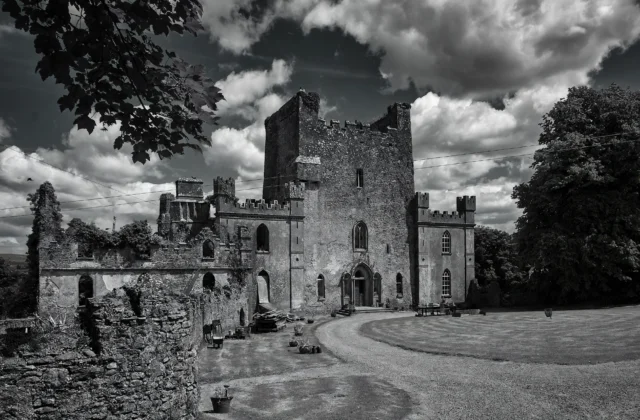
Borley is barely a village at all. Fewer than 120 people live scattered about its farmhouses and lanes, near the Essex–Suffolk border, and it has no shop, no pub, no real center beyond a scattering of listed buildings around a Grade I church on a low hill. And yet for most of the twentieth century, this was one of the most famous addresses in England, because a red-brick Victorian rectory once stood across the lane from that church, and for nearly eighty years people swore it was the most haunted house in the country.
The rectory is gone now, demolished in 1944, and the church still stands, still holds services, and, according to the people who spend decades investigating it, is still not empty.
The Rectory That Made Borley Famous
Borley Rectory was built in 1863 by the Reverend Henry Dawson Ellis Bull, Borley’s first rector, a two-story red-brick house of twenty-three rooms, set in nearly four acres, standing directly opposite the parish church.
Local legend held that it had been built on the site of a monastery, where a monk fell in love with a nun and was beheaded for his pains, while she was walled up alive, and that a phantom coach driven by a headless coachman regularly swept up and away from the grounds; neither the monastery nor a nunnery said to be connected with the tale has ever been unearthed by historians.
A second legend, dating from the 1940s, was more specific: that a French Catholic nun, who had married into the Waldegrave family, the Elizabethan Catholic dynasty whose tombs still dominate Borley Church’s chancel, had been strangled by her husband in 1667 in a building which was to become the rectory, and buried beneath the cellar floor; a clergyman who investigated the claim – Canon W. J. Phythian-Adams – found that the woman could have been a Frenchwoman known as “Marie Lairre.”
Whatever its origins, the rectory’s reputation for strange happenings preceded it by some years, and a servant of the Bull family reported hearing unexplainable footsteps in the 1880s. P. Shaw Jeffrey, later headmaster of Colchester Royal Grammar School, was a guest at the rectory in 1885 and 1886 and saw stones falling from nowhere, objects moving of their own accord, and had numerous sightings of “the nun,” as well as the sound of the phantom coach rumbling past; on the afternoon of July 28, 1900, four of Henry Bull’s daughters saw the figure of a nun crossing the garden in broad daylight.
The rectory passed from one occupant to another: Henry Bull’s son Harry Bull until he died in 1927, briefly the Reverend Guy Eric Smith and his wife starting in 1928, and finally, in 1930, the Reverend Lionel Foyster, a cousin of the Bulls, who moved in with his wife Marianne and a young adopted daughter. It was during the Foysters’ five years at Borley that the case really became bizarre, and it was Harry Price, the psychical researcher the Smiths had called the year before, who made sure the world knew about it.
Why Borley Is Considered One of England’s Most Haunted Places
The Phantom Nun and the Ghost Hunter from the Daily Mirror

By 1929, the Smiths had become so frustrated by the rumors regarding the new house that they asked the Daily Mirror to investigate the haunting. The newspaper assigned the task to Harry Price, the director of the National Laboratory for Psychical Research, who happened to be a professional magician, which was a vital skill in detecting forgeries.
Price arrives at Borley
In June 1929, he arrived at Borley with his secretary and a reporter from the Daily Mirror and questioned the incumbents, the rectory maid, the gardener, the carpenter, members of the Bull family, and residents. He uncovered a number of poltergeist disturbances that occurred that very evening, including “a glass roof shattered,” a candlestick broken, “pebbles sent flying,” and “spirit raps” during an impromptu séance. The local newspaper printed a series of articles about the investigation, making Price a celebrity within the science press. The Smiths left the village within a few weeks due to the persistent tourists and abandoned their position as rector the following year.
The Foysters and the Writing on the Wall
The Foysters moved in that October, and, according to Price’s subsequent accounts, things grew exponentially worse over the next two years, culminating in more than two thousand incidents (by his count) of footfalls, bells, whisperings, the sudden appearance of incense and perfume, thrown objects, shattered glass, overturned furniture, small conflagrations, and messages that seemed to appear, fully formed, on the walls and on scraps of paper, often directed at Marianne.
Wine in a bottle on one occasion was said to have been turned to ink, and Marianne was allegedly thrown from her bed on another. Lionel Foyster kept a written diary, the Diary of Occurrences, of the events, and Price himself was suspicious about at least one occurrence involving Marianne directly, and a Society for Psychical Research member who visited the couple privately warned them to be wary of Price’s hunger for publicity, a warning that would prove to cut both ways.
The rectory stood empty until Price rented it himself from 1937 until 1938, after the Foysters left in 1935, enlisting 48 “official observers” via a newspaper appeal to keep a systematic watch, one of whom, engineer Sidney Glanville, ran planchette séances with his daughter Helen, during which a “spirit” who identified herself as a nun named Marie Lairre is said to have revealed that she had been murdered at Borley and buried on the grounds, seemingly confirming the older Waldegrave legend.
Fire, a Coffin Jaw, and a Levitating Brick
The rectory’s next owner took possession in December 1938 and, just months later, on the night of 27 February 1939, an overturned oil lamp set fire to the building, gutting much of the structure. The ruin didn’t stop the interest.
A Cambridge lecturer organized twenty-five overnight vigils among students in the wrecked shell before it was finally demolished in 1944, and in 1943, excavations Price supervised in the cellars and the church turned up a human jawbone along with medallions and other small objects, which Price presented as corroborating evidence for a murdered woman on the property, though the bones’ age and origin were later disputed. During the demolition itself, a Life magazine photographer captured an image Price described as a brick caught mid-levitation, a photograph that remains one of the case’s most argued-over pieces of “evidence.”
Debunked? The 1956 Verdict, and the Rebuttal That Followed
Harry Price died in 1948, and the Society for Psychical Research wasted no time in launching its own inquiry into his most famous case, publishing a report in 1956 (A Further Investigation of the Borley Ghosts) by Eric Dingwall, Kathleen ‘Mollie’ Goldney and Trevor Hall, which concluded that Price had presented a ‘deliberately distorted account of the Borley affair’ in his books, and that ‘simple explanations such as the activities of vermin, drafts and domestic accidents, coincidences or even deliberate deception’ were likely to account for the great majority of reported phenomena.
Around the same time, a Daily Mail reporter who had accompanied Price in 1929 accused him outright of having thrown some of the pebbles himself.
It hasn’t always been a one-sided verdict, though. In 1969, researcher Robert Hastings published a lengthy rebuttal, through the same Society, to this report, arguing the authors had approached the case with their own agenda, in an attempt to discredit Price personally, and had exploited questionable interpretations of their own.
Meanwhile, reviewers of the wider literature since have described the 1956 report as both ‘a devastating critique’, and ‘a curious volume’ in its own right, according to a 1979 Folklore review. Marianne Foyster herself, interviewed decades later, gave conflicting accounts, at different points suggesting her husband had fabricated some events for a planned book deal, while insisting that others genuinely had no explanation either of them could explain.
The Haunting Moves to the Church
Here’s the detail that kept Borley’s house on the books long after its foundations had been excavated: witnesses say that the activity did not cease when the building was bulldozed, but crossed the lane into the churchyard, where reports of phantom organ music, unexplained chanting, and a ghostly nun figure have also been logged for decades, along with the occasional sighting inside the nave of a hooded, monk-like figure.
In the 1970s, the American paranormal investigators Ed and Lorraine Warren, who would eventually launch the Conjuring film franchise, visited Borley Church specifically to investigate and reportedly encountered a robed figure both in the churchyard and inside the building. The church’s continued reputation, and the volume of visitors it draws as a result, eventually got serious enough that closed-circuit cameras and other security measures were installed to deter rowdy nighttime trespassers.
None of this amounts to proof, and the case’s most thorough investigators have spent nearly a century disagreeing with each other about how much of it was fraud, suggestion, or something genuinely unexplained. But few reputedly haunted places on earth have been picked apart this carefully, by professional researchers, tabloid reporters, and skeptical societies alike, and still come out the other side with a mystery intact.
Visiting Borley Church Today

Borley Church, dedication unknown, stands on Hall Road, Borley, Essex, CO10, approximately two miles from Sudbury, Suffolk. This Church of England parish church is currently active, part of the Borley and Liston parish, North Hinckford Team ministry, Diocese of Chelmsford, and hosts regular Sunday services open to the public, but it’s advisable to check the North Hinckford parish website or contact the team office beforehand, as services are held in the benefice’s various churches on a rotating basis.
The Grade I listed building has a possible nave dating back to the eleventh century, and a largely Perpendicular chancel and tower from the fourteenth to the sixteenth century, while the topiary walk leading to the south porch was replaced by a wheelchair-accessible brick path in 2017. Inside, the church is notable for the large monument to Sir Edward Waldegrave and his wife, members of the Elizabethan-era family whose name is familiar to most from the various iterations of the ghost story said to involve the house.
The rectory itself is long gone, its grounds divided up into private residences, and there’s little point in trying to see anything on the site beside the road, where the church stands opposite. This is a matter of practicality as much as anything else, as Borley is a small, quiet residential parish, with no real public transport on offer beside the odd bus, and local people have grown sick of ghost hunters wandering up and down the narrow lanes on Halloween, or blocking the road at night.
Visitors are urged to treat the church as a working village and place of worship, rather than some kind of roadside attraction, and to be respectful of residents and their privacy, and any noticeboards or other signs of restricted access.
Do you think there’s anything to it, or is it just a good story, well told? Let us know in the comments below.
Sources consulted for the historical details in this post include Joanna Timms, “Ghost-Hunters and Psychical Research in Interwar England,” History Workshop Journal*, No. 74 (Autumn 2012), pp. 88–104 ; Jacqueline Simpson, review of* Dictionary of the Supernatural by Peter Underwood, Folklore*, Vol. 90, No. 1 (1979), pp. 117–118 ; Peter Opie, “Other Recent Publications” (note on Dingwall, Goldney & Hall’s* The Haunting of Borley Rectory*),* Folklore*, Vol.
67, No. 4 (Dec. 1956), pp. 255–256; A. V. Seaton, “GHOSTS,” in* Keywords for Travel Writing Studies: A Critical Glossary (Anthem Press, 2019), pp. 105–107; Melvyn Willin, “Borley Rectory,” Psi Encyclopedia*, Society for Psychical Research (last updated 2026), psi-encyclopedia.spr.ac.uk/articles/borley-rectory; Wikipedia’s entries on Borley Church and Borley, Essex; and A Church Near You’s page for the Borley benefice for current visiting and service information.*